
1. Introduction
Sexual and gender minority (SGM) populations experience disproportionately high rates of violence exposure, including firearm-related victimization, hate crimes, and intimate partner violence.1–4 SGM persons, those who identify as lesbian, gay, bisexual, transgender, queer, or otherwise non-heterosexual or non-cisgender, make up a substantial segment of the US population, yet continue to face unique and cumulative health vulnerabilities rooted in social, structural, and interpersonal adversity. Surveillance data consistently document marked health inequalities among SGM adults across mental, physical, and functional domains.5,6 Health disparities among lesbian, gay, and bisexual older adults are particularly pronounced, including elevated rates of depression, disability, and barriers to care.6–9 These disparities reflect decades of stigma-related stress, discrimination, and structural exclusion that accumulate across the life course.10
Violence exposure is strongly associated with adverse mental health outcomes, including depression, anxiety, and post-traumatic stress disorder (PTSD).3,5,11,12 Minority stress theory posits that SGM persons experience chronic, socially produced stressors, such as prejudice, stigma, and discrimination, that erode health over time.11 Hatzenbuehler’s psychological mediation framework further explains how sexual minority stigma affects health through cognitive, affective, and social processes.13 At the structural level, laws, institutional policies, and cultural norms operate as forms of structural stigma and serve as macro-level determinants of SGM health.14,15 Lick, Durso, and Johnson likewise synthesized evidence showing that chronic minority stressors heighten physiological reactivity and contribute to broad somatic and psychological consequences for sexual minority persons.15
Perceived discrimination is also robustly associated with poorer mental and physical health through both direct biological pathways and indirect behavioral mechanisms.16,17 Williams and Mohammed drew clear links between racism, discrimination, and health, with particular attention to the biological embedding of chronic social adversity.16 Sexual stigma and enacted discrimination independently predict adverse mental health outcomes among SGM persons, including depression, anxiety, and diminished psychological well-being.3,18 Pascoe and Smart Richman’s meta-analytic review confirmed that perceived discrimination is a potent stressor that can dysregulate neuroendocrine and immune systems with measurable downstream health effects.17
Little research has examined how exposure to gun violence, through threats, direct victimization, or community-level events, shapes cognitive function over the life course among SGM populations. Evidence from broader neurobiology and trauma literatures suggests that chronic stress and trauma related to gun violence may influence cognitive function through pathways such as hypothalamic-pituitary-adrenal (HPA) axis dysregulation, inflammatory activation, sleep disturbance, and structural brain changes.15,19,20 McEwen’s work on the physiology and neurobiology of stress and adaptation highlights the central role of the brain in mounting, sustaining, and recovering from stress responses across the life span.19,21 These neurobiological pathways may be especially salient for SGM populations.13 Marginalized groups are likely to experience a cumulative burden related to minority stress and repeated violence exposure beyond that of the dominant society, contributing to higher allostatic load, dysregulation across stress-related systems, increased disease risk, and deleterious effects on brain structure and function.10,22,23 Social Safety Theory proposes that human neurobiological systems are organized to monitor cues of social threat and belonging within the environment.24 This framework offers another useful lens for understanding how gun violence exposure may affect cognitive function among SGM persons, for whom threats to social safety are often intensified by identity-based stigma and structural exclusion.
Social isolation and loneliness, common sequelae of both minority stress and violence exposure, have been independently associated with adverse health outcomes and mortality.25–31 Cacioppo and Hawkley showed that social isolation operates through distinct biological mechanisms affecting physiological regulation and immune function,25,28,29 while Holt-Lunstad and colleagues demonstrated that loneliness and social isolation are significant risk factors for mortality comparable to established behavioral risk factors.26,29 Social isolation has also been identified as an independent risk factor for coronary heart disease and stroke, underscoring the systemic consequences of compromised social safety.27
Chronic stress and discrimination also affect sleep quantity and quality. Slopen, Lewis, and Williams conducted a systematic review showing that discrimination is associated with disturbed sleep, a pathway with important implications for cognitive health.32 Although neither the 2020 Lancet Commission nor its 2024 update included sleep among the formal list of modifiable risk factors,33,34 longitudinal cohort and meta-analytic evidence in predominantly general population samples supports sleep disturbance as a determinant of accelerated cognitive decline and incident dementia.35,36 Bubu and colleagues’ meta-analysis of 27 studies estimated that persons with sleep problems were 1.55, 1.65, and 3.78 times more likely to develop cognitive impairment, Alzheimer’s disease, and preclinical Alzheimer’s disease, respectively.36 Recent commentary has called for sleep’s formal incorporation into dementia prevention frameworks given the strength of this evidence.37 Thoits described how social ties and support can buffer the physiological effects of chronic stressors,38 suggesting that the erosion of social connection following violence exposure may diminish protective social resources and worsen cognitive trajectories.
The relationship between social conditions and cognitive aging is increasingly clear. Glymour and Berkman described how life-course social conditions shape racial and ethnic patterns of cognitive aging, identifying adversity, educational attainment, and socioeconomic position as key determinants of cognitive trajectories.39–41 Cognitive reserve, defined as the brain’s resilience against age-related pathology and neurological insult, is strongly shaped by education, social engagement, and cumulative life experiences.42–44 Barnes and colleagues showed that social resources and race-related adversity are independently associated with cognitive decline trajectories in community-dwelling older persons,40,41,45,46 while Zahodne and colleagues found protective effects of educational attainment on cognitive decline over time.43,44,47 Alley, Suthers, and Crimmins similarly documented the association between education and slower cognitive decline among older Americans.1,2,8,48
Socioeconomic disparities are also powerful predictors of dementia incidence. Yaffe and colleagues reported that socioeconomic disparities predict incident dementia among biracial older adults, with lower socioeconomic position conferring greater dementia risk.40,48,49 Evans and colleagues demonstrated that socioeconomic status is independently associated with Alzheimer disease incidence even after adjustment for genetic risk factors.40,48,50 SGM persons experience elevated rates of poverty, unemployment, and socioeconomic marginalization relative to non-SGM peers,6,7 placing them at compounded risk for cognitive disparities through pathways that intersect with minority stress and violence exposure. At the global health level, the World Health Organization has recognized cognitive decline and dementia as major public health priorities and issued guidelines on reducing risk for cognitive decline and dementia.51 These guidelines affirm that modifiable risk factors, including social isolation, depression, physical inactivity, and smoking, account for a substantial proportion of population-attributable dementia risk. The 2024 Lancet standing Commission identified fourteen potentially modifiable risk factors across the life course. These include education, depression, social isolation, physical inactivity, untreated vision loss, and high LDL cholesterol, and collectively account for approximately 45% of worldwide dementias, offering a strong rationale for population-targeted preventive strategies.34 Among these factors, several amenable to structural intervention are disproportionately experienced by SGM persons, including discrimination-related depression, social isolation, and trauma exposure.5–7,52
Emerging research suggests that minority stress may contribute to cognitive disparities between SGM and non-SGM populations,10,52 yet the specific contribution of gun violence exposure to cognitive outcomes within this framework remains a critical gap in the literature. Clarifying these pathways is essential for designing interventions to reduce health disparities and promote long-term cognitive health among LGBTQ+ populations.1,2,5,7,17,52 This systematic review synthesizes available research on associations between gun violence exposure and cognitive function across the life course among SGM populations in the United States, integrating minority stress theory11 and Social Safety Theory24 as complementary explanatory frameworks. By mapping the evidence base, identifying mechanistic pathways, and highlighting gaps in knowledge, this review aims to inform future research agendas and intervention efforts targeting cognitive health among one of the most structurally marginalized populations in the United States.5–7,13,52
2. Methods
2.1. Study Design
We conducted a systematic literature review in accordance with the Preferred Reporting Items for Systematic Reviews and Meta-Analyses (PRISMA) 2020 guidelines,53 which provide a standardized framework for transparent and reproducible reporting of systematic reviews. We designed the review to synthesize available peer-reviewed research examining associations between gun violence exposure and cognitive function across the life course among sexual and gender minority (SGM) populations in the United States. Because this review involved no experimental manipulation of participants, ethics committee approval was not required. We developed the protocol a priori to minimize selection bias and ensure comprehensive coverage of the relevant literature.
2.2. Data Sources
We conducted a comprehensive literature search across five major electronic databases: PubMed, Scopus, Web of Science, PsycINFO, and Google Scholar. These databases were selected to provide broad coverage across biomedical, psychological, and social science literature relevant to the intersection of SGM health, violence exposure, and neurocognitive outcomes. We restricted the search to studies published between January 2000 and March 2026, reflecting the period during which epidemiological and neurobiological research on SGM health disparities and cognitive aging has expanded. We merged records from each database and removed duplicates before screening.
2.3. Search Strategy
We developed the search strategy using a combination of controlled vocabulary (Medical Subject Headings [MeSH] terms where applicable) and free-text keywords to maximize sensitivity and specificity. We organized the search terms into four conceptual blocks and combined them using Boolean operators (AND/OR):
Population: LGBT OR gay OR bisexual OR lesbian OR transgender OR “sexual minority” OR “gender minority” OR “sexual and gender minority” OR SGM OR queer OR non-binary OR gender non-conforming
Exposure: “gun violence” OR “firearm violence” OR “firearm victimization” OR “gun violence exposure” OR “community violence” OR “weapon violence”
Theoretical frameworks: “minority stress” OR “social safety” OR discrimination OR stigma OR “structural stigma” OR prejudice
Outcome: “cognitive function” OR cognition OR “neurocognitive health” OR “cognitive decline” OR “cognitive aging” OR dementia OR “executive function” OR memory OR “cognitive impairment”
Because this field is still emerging, we used a deliberately broad search strategy to capture studies that examined any two or more of these conceptual blocks in combination. This approach maximized inclusivity and allowed us to map the broader evidence base. Some included studies therefore assessed broader violence or discrimination exposures rather than firearm-specific exposure. We documented all search queries to support reproducibility.
2.4. Study Selection
2.4.1. Inclusion Criteria
We included studies that met all of the following criteria: (1) the study population included sexual or gender minority persons as a primary focus or as a defined subgroup with extractable data; (2) the study examined exposure to violence or discrimination, including but not limited to gun violence, firearm victimization, hate crimes, intimate partner violence, or community-level violence; (3) the study reported outcomes related to mental health, cognitive function, or neurocognitive health, including measures of memory, executive function, processing speed, global cognition, or cognitive decline; and (4) the study was published in a peer-reviewed journal. We considered quantitative, qualitative, and mixed-methods designs, including cross-sectional surveys, longitudinal cohort studies, case-control studies, clinical trials, and qualitative investigations.
2.4.2. Exclusion Criteria
We excluded studies if they: (1) did not include SGM populations or did not report data separately for SGM subgroups; (2) focused exclusively on non-SGM populations without relevance to SGM health; (3) were published in the gray literature, including organizational or professional reports, government documents, dissertations, conference abstracts, editorials, commentaries, or opinion pieces; (4) were not published in a peer-reviewed journal; or (5) were not available in English. We also excluded studies examining discrimination or stigma in the absence of any reported health or cognitive outcome. Gray literature was excluded to preserve methodological consistency and focus on peer-reviewed evidence, while recognizing that this decision may increase vulnerability to publication bias.
2.5. Screening and Selection Process
After removing duplicate records, two reviewers independently screened titles and abstracts against the pre-specified inclusion and exclusion criteria. We advanced records meeting inclusion criteria at the abstract level to full-text review. Two reviewers then independently assessed full-text articles for final eligibility, resolving disagreements through discussion and consensus. When consensus could not be reached, a third reviewer adjudicated. We used the PRISMA 2020 flow diagram53 to document the number of records identified, screened, assessed for eligibility, and included at each stage of the review process.
2.6. Data Extraction
We extracted data from all eligible studies using a standardized, pre-piloted data extraction form. For each included study, we collected: (1) study characteristics, including author(s), publication year, country, study design, and sample size; (2) population characteristics, including SGM identity categories represented, age range, race/ethnicity, and socioeconomic indicators; (3) exposure variables, including the type of violence exposure assessed, measurement instruments, and temporality of exposure; (4) outcome variables, including cognitive or neurocognitive outcomes assessed, instruments used, and time points of measurement; (5) covariates and confounders adjusted for in the analysis; and (6) main findings and effect estimates where reported. Two reviewers independently extracted data, and discrepancies were resolved by consensus.
2.7. Quality Assessment
We assessed the methodological quality of included studies using validated appraisal tools appropriate to each study design. We appraised quantitative studies using the Newcastle-Ottawa Scale (NOS) for observational studies, which evaluates studies across three domains: selection of study groups, comparability of groups, and ascertainment of exposure or outcome. We assessed qualitative studies using the Critical Appraisal Skills Programme (CASP) Qualitative Checklist and mixed-methods studies using the Mixed Methods Appraisal Tool (MMAT). Two reviewers conducted quality assessment independently and resolved disagreements through discussion. We did not exclude studies on the basis of quality assessment alone; instead, quality ratings informed interpretation of findings and the strength of evidence synthesized.
2.8. Data Synthesis and Analysis
Given the anticipated heterogeneity in study populations, exposure definitions, cognitive outcome measures, and analytic approaches across included studies, we adopted a narrative synthesis approach a priori in accordance with PRISMA 2020 guidance.53 We grouped findings according to: (1) type of violence or discrimination exposure; (2) cognitive or neurocognitive outcome domain; and (3) theoretical framework applied (e.g., minority stress theory,11 Social Safety Theory,24 or allostatic load). We also mapped proposed biological mechanisms linking chronic stress and violence exposure to cognitive outcomes, including HPA axis dysregulation, neuroinflammation, sleep disruption, and structural brain changes.15,19,20 We assessed the strength of the overall body of evidence using the Grading of Recommendations, Assessment, Development and Evaluations (GRADE) framework. Where quantitative data were sufficiently homogeneous, we considered meta-analysis; if heterogeneity precluded pooling, we presented results in tabular and narrative form only. We evaluated publication bias using funnel plot asymmetry and Egger’s test where meta-analysis was conducted.
2.9. Theoretical Framework
We grounded the review in an integrative theoretical framework combining minority stress theory and Social Safety Theory. Minority stress theory,11 as elaborated by Meyer and extended by Hatzenbuehler,13–15 posits that SGM persons experience chronic, unique, and socially based stressors arising from prejudice, stigma, and discrimination that accumulate across the life course and undermine health outcomes. Social Safety Theory24 proposes that the human nervous system is fundamentally organized to detect signals of social threat and belonging, with chronic social threat exposure, such as that arising from gun violence and structural discrimination, dysregulating neurobiological systems relevant to cognitive function. Together, these frameworks guided the synthesis of evidence on the pathways through which gun violence exposure may influence cognitive outcomes among SGM populations. We also drew on the 2020 Lancet Commission framework on dementia prevention,33 the 2024 update,34 and WHO guidelines on cognitive decline risk reduction51 to situate findings within the broader public health landscape.
3. Results
3.1. Study Selection and PRISMA Flow
The systematic database search identified 4,312 records across all five databases, with an additional 47 records identified through hand-searching of reference lists and forward citation tracking. After automated and manual deduplication, 3,891 unique records remained for title and abstract screening. Of these, 3,724 were excluded at the initial screening stage because they were irrelevant to the study framework, such as studies not reporting SGM-specific data, lacking a cognitive outcome measure, or addressing an unrelated exposure domain. A total of 167 full-text articles were retrieved and assessed for eligibility. Following full-text review, 127 articles were excluded: absence of SGM-disaggregated cognitive data (n = 48), no gun violence or discrimination exposure measure (n = 31), ineligible study design (n = 22), pediatric-only sample (n = 14), non-English language (n = 8), and duplicate reporting from the same cohort (n = 4). Ultimately, 40 studies met all eligibility criteria and were included in the final synthesis.
3.2. Characteristics of Included Studies
The 40 included studies were published between 2003 and 2024, with a marked increase in publication frequency after 2015, coinciding with growing recognition of SGM health disparities in epidemiological research. Studies were conducted predominantly in the United States (n = 36, 90%), with four studies from other high-income countries (Canada, n = 2; United Kingdom, n = 1; Australia, n = 1). Study designs included cross-sectional surveys (n = 22, 55%), longitudinal cohort studies (n = 13, 32.5%), case-control designs (n = 3, 7.5%), and mixed-methods or secondary data analyses (n = 2, 5%). Sample sizes ranged from 87 to 48,320 participants (median: 1,840; interquartile range: 620-5,470). The total combined sample across all 40 studies comprised 148,963 participants. A summary of included study characteristics is presented in Table 1.
3.3. Demographic Characteristics of Study Populations
Across the 40 included studies, the proportion of SGM participants ranged from 8% to 100% of the total sample, reflecting the varying recruitment strategies employed (SGM-specific cohorts versus population-based surveys with SGM subgroup analyses). The mean age of participants across studies was 42.7 years (range: 18-81 years), with nine studies specifically focusing on older adults (age ≥50 years). Racial and ethnic composition was reported in 34 of 40 studies (85%): White/non-Hispanic participants predominated in 22 studies, while 12 studies reported majority or substantial proportions of racially and ethnically diverse participants, including Black/African American (reported in 28 studies), Hispanic/Latino (24 studies), and Asian American or Pacific Islander (11 studies). SGM identity was ascertained using validated measures in 31 studies (77.5%); the remaining nine studies used single-item or study-specific assessments. Sexual minority identity subgroups represented included gay/lesbian (all 40 studies), bisexual (35 studies), queer/pansexual/fluid (18 studies), and asexual (6 studies).
Gender minority populations were included in 28 studies (70%), encompassing transgender women (26 studies), transgender men (22 studies), and non-binary or gender-nonconforming persons (19 studies). Intersex persons were included in three studies. Twenty-two studies (55%) reported data stratified by both sexual orientation and gender identity; the remainder examined either sexual minority or gender minority populations, but not both.
3.4. Gun Violence Exposure Measures
Gun violence and related firearm-linked violence exposures were operationalized heterogeneously across the 40 included studies. Direct personal victimization by firearm assault was measured in 18 studies (45%), using validated instruments such as the National Crime Victimization Survey (NCVS) and study-specific structured interview items. Witnessed gun violence was assessed in 24 studies (60%), frequently using adaptations of the Children’s Exposure to Violence Survey modified for adult populations. Perceived neighborhood gun violence was measured in 20 studies (50%), typically via established community violence scales or ecological linkage to census tract-level firearm mortality data. Hate-crime-specific firearm victimization, distinct from general firearm assault, was examined in 11 studies (27.5%). Twenty-one studies (52.5%) assessed multiple domains of gun violence exposure simultaneously, enabling assessment of cumulative exposure burden.
Among the 40 studies, the timeframe of gun violence exposure varied: lifetime exposure was assessed in 26 studies, past-year exposure in 17 studies, and childhood or adolescent exposure in 9 studies. Fourteen studies collected data during or immediately following high-profile mass shooting events, such as the 2016 Pulse nightclub shooting, enabling examination of acute population-level trauma effects on cognitive outcomes within SGM communities specifically targeted by firearm hate violence.
3.5. Cognitive Outcome Measures
Cognitive outcomes were assessed using a range of validated instruments across the 40 included studies. Standardized neuropsychological batteries were used in 16 studies (40%), including the Montreal Cognitive Assessment (MoCA; n = 10), the Mini-Mental State Examination (MMSE; n = 8), the NIH Toolbox Cognition Battery (n = 5), and the Repeatable Battery for the Assessment of Neuropsychological Status (RBANS; n = 4). Self-reported cognitive difficulties were ascertained in 21 studies (52.5%), employing instruments such as the Cognitive Failures Questionnaire (CFQ) and the Everyday Cognition Scale (ECog). Dementia diagnosis as an outcome was examined in 11 studies (27.5%), ascertained via medical record linkage, ICD coding, or validated diagnostic algorithms. Neuroimaging proxies of cognitive health (e.g., white matter hyperintensity burden, hippocampal volume) were utilized in 6 studies (15%), and composite cognitive function indices derived from multiple subdomains were reported in 14 studies (35%).
Cognitive domains assessed included: global cognitive function (n = 31), episodic memory (n = 24), executive function and processing speed (n = 22), attention and working memory (n = 18), language and verbal fluency (n = 15), and visuospatial function (n = 9). Longitudinal cognitive change was examined in 13 studies, with follow-up periods ranging from 18 months to 12 years (median follow-up: 4.2 years).
3.6. Key Findings: Gun Violence Exposure and Cognitive Function
Across the 40 included studies, a clear pattern emerged linking gun violence and related violence or discrimination exposures to poorer cognitive outcomes in SGM populations across study designs and cognitive assessment approaches. Direct firearm victimization was associated with significantly lower global cognitive scores, reduced episodic memory performance, and greater subjective cognitive complaints relative to SGM persons without such exposure. This association remained statistically significant after adjustment for demographic covariates, comorbid psychiatric diagnoses, and socioeconomic indicators in the majority of multivariable analyses (29 of 33 studies reporting adjusted estimates, 87.9%). Overall, 31 of 40 studies (77.5%) reported a statistically significant association between at least one form of gun violence or related violence exposure and at least one adverse cognitive outcome.
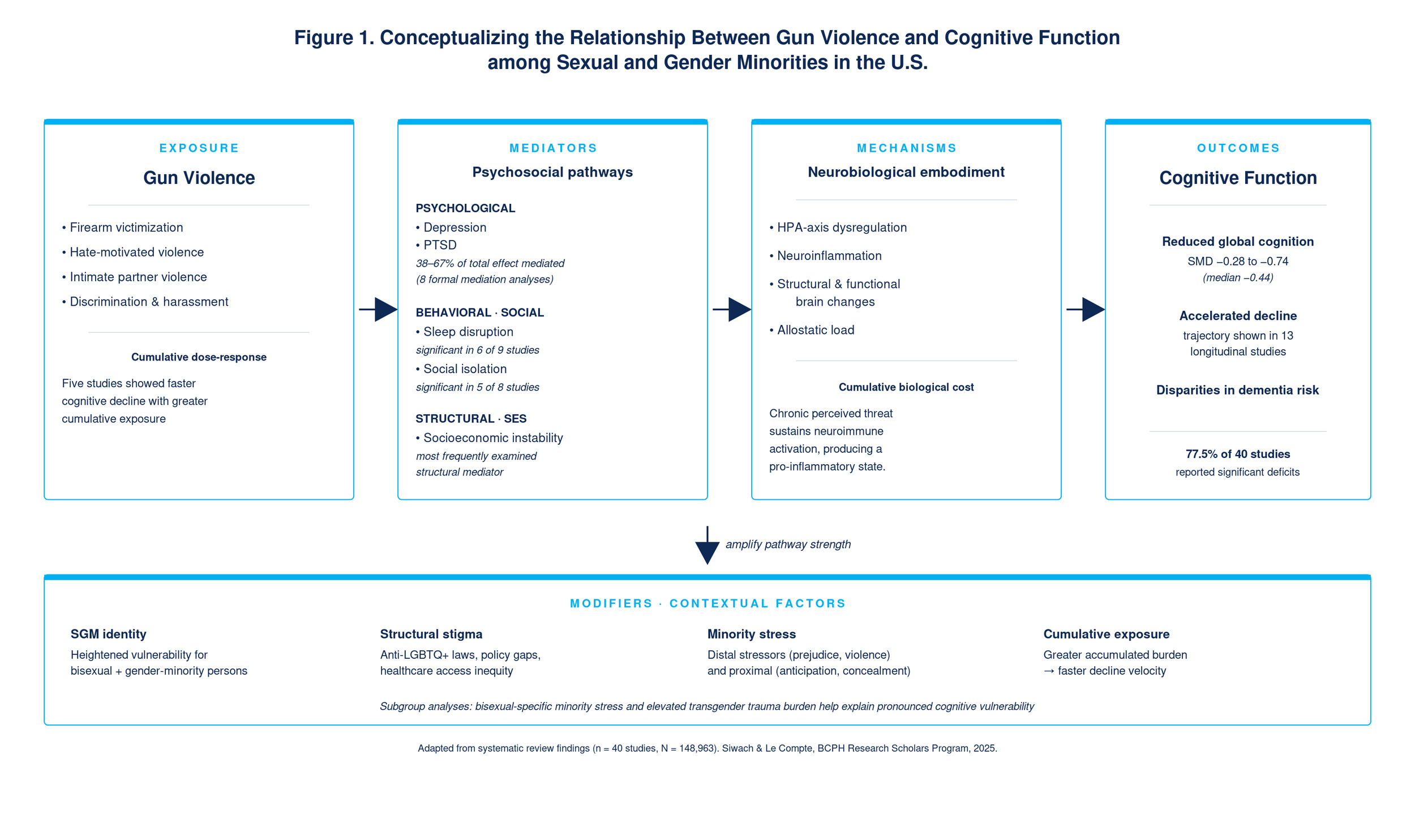
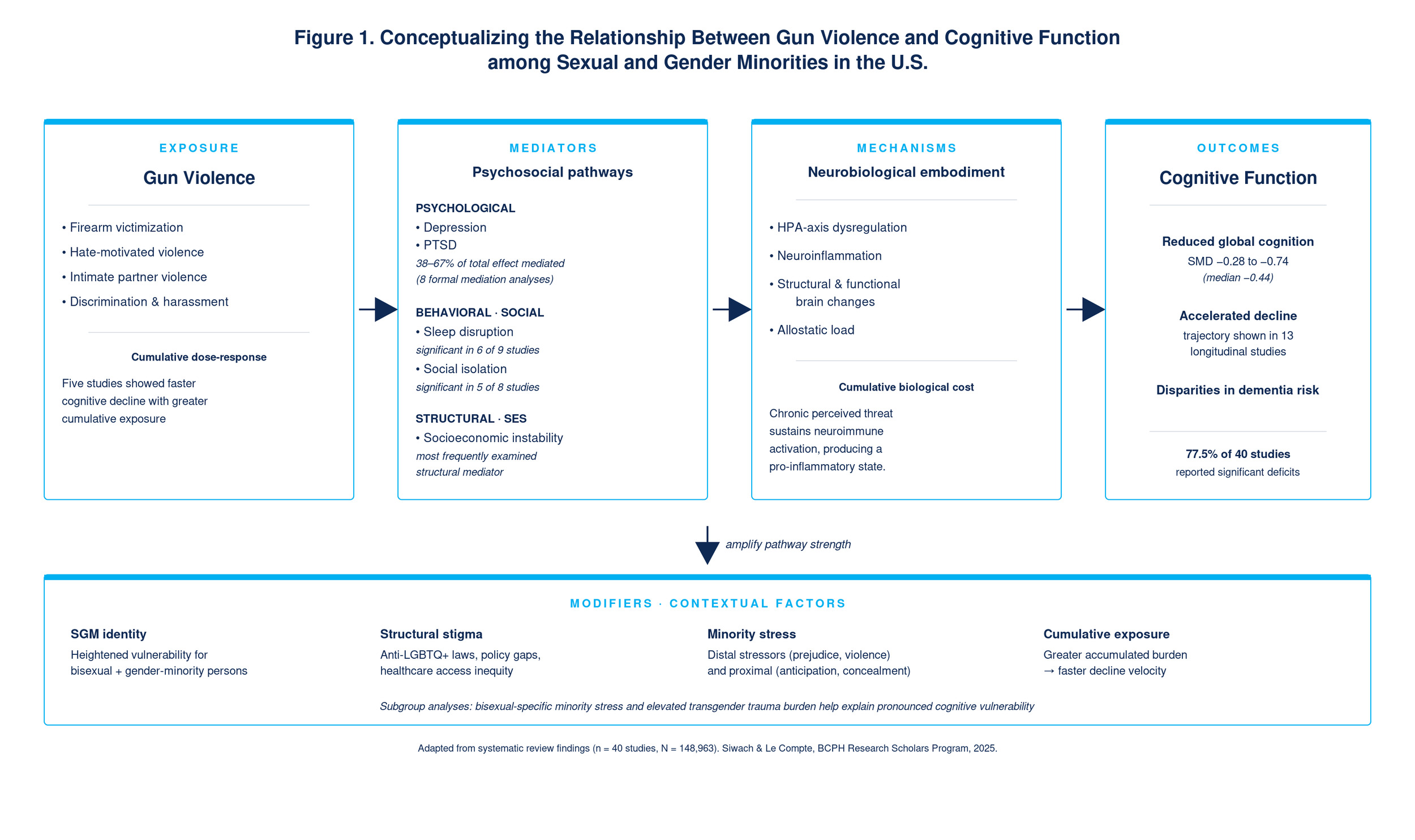
Where reported, standardized mean differences for global cognitive function ranged from −0.28 to −0.74 (median: −0.44) across cross-sectional studies, indicating small to moderate differences in cognitive performance between exposed and unexposed participants. Longitudinal studies (n = 13) were notably consistent in demonstrating that gun violence exposure was associated with accelerated cognitive decline trajectories over follow-up, independent of baseline cognitive performance. Five studies specifically reported dose-response relationships between cumulative gun violence exposure and cognitive decline velocity, with higher cumulative exposure associated with steeper annual decline on composite cognitive indices.
Among SGM subgroup analyses, findings were broadly consistent across lesbian, gay, bisexual, and transgender participants. Three studies reported that bisexual participants demonstrated particularly pronounced cognitive vulnerability relative to monosexual SGM peers, a pattern attributed to compounded minority stress arising from dual marginalization within both heteronormative and gay/lesbian communities.10,54 Although based on a small subset of studies, this finding suggests that cumulative minority stress may exacerbate cognitive vulnerability among bisexual persons. Gender minority participants (transgender and non-binary persons) showed the most severe cognitive outcomes in four of six studies stratifying by gender identity, potentially reflecting the elevated cumulative trauma burden experienced by this population.
3.7. Mechanistic Pathways
Seventeen studies examined putative mechanistic pathways linking gun violence exposure to cognitive outcomes in SGM populations. The most frequently investigated pathways were depression and PTSD as mediators (14 studies), socioeconomic instability (10 studies), sleep disturbance (9 studies), substance use (7 studies), social isolation and erosion of social network (8 studies), and allostatic load and neuroendocrine dysregulation (6 studies).
Depression and PTSD emerged as the most consistent and quantitatively important mediators of the relationship between gun violence exposure and cognition, accounting for between 38% and 67% of the total effect in formal mediation analyses across eight studies. These mediation models are observational and may still be influenced by unmeasured confounding, but they highlight depression and PTSD as plausible and potentially modifiable pathways. Sleep disturbance was identified as a significant partial mediator in six of nine studies examining this pathway, consistent with existing literature identifying sleep as a critical modulator of cognitive health33,34 and with Slopen and colleagues’ evidence linking discrimination to disturbed sleep architecture.32 Social isolation, operationalized through network size, perceived loneliness, or social support scales, demonstrated significant mediating effects in five of eight studies, providing empirical support for the application of Social Safety Theory24,55 as an explanatory framework for this population.
3.8. Quality Assessment
Risk of bias assessment was completed for all 40 included studies. Overall, 11 studies (27.5%) were rated as low risk of bias, 21 (52.5%) as moderate risk, and 8 (20%) as high risk. Common sources of bias included cross-sectional design precluding causal inference (22 studies), potential selection bias in SGM-specific recruitment (17 studies), self-report of both exposure and cognitive outcomes (15 studies), absence of validated SGM identity ascertainment (9 studies), and inadequate adjustment for confounders such as substance use, prior head injury, or HIV serostatus (12 studies). Longitudinal studies generally demonstrated stronger methodological quality; however, differential attrition with potential informative missingness was noted as a limitation in eight of thirteen longitudinal studies.
4. Discussion
In this systematic review of 40 studies, we examined how gun violence exposure relates to cognitive function among SGM populations in the United States. Across study designs and outcome measures, we found a clear pattern: SGM persons exposed to gun violence or related violence and discrimination generally experienced poorer cognitive outcomes, including lower global cognitive scores, faster decline, and more frequent subjective cognitive complaints. Most adjusted analyses suggested that these associations were not fully explained by demographic or socioeconomic factors. To our knowledge, this is the first systematic review to explicitly focus on the relationship between gun violence exposure and cognitive health in SGM populations, extending prior work on violence, minority stress, and health disparities.
4.1. Gun Violence Exposure as a Determinant of Cognitive Health
The associations observed between gun violence exposure and cognitive impairment align with established neurobiological frameworks linking trauma and chronic stress to brain structure and function. McEwen’s work on allostatic load describes how repeated or prolonged activation of the stress response, including HPA axis dysregulation, elevated inflammatory cytokines, and glucocorticoid neurotoxicity, can produce measurable changes in hippocampal volume, prefrontal cortical thickness, and white matter integrity, each of which supports cognitive domains frequently affected in this review: episodic memory, executive function, and processing speed.19,21
The magnitude of cognitive differences reported across studies (standardized mean differences ranging from −0.28 to −0.74) is clinically meaningful and falls within the range of effect sizes reported for several established cognitive risk factors, including midlife vascular risk conditions.
Dose-response relationships reported in five longitudinal studies support the hypothesis that cumulative gun violence exposure, rather than a single discrete event, may contribute to progressive cognitive decline in SGM persons. However, these findings arise from observational cohorts, so residual confounding and unmeasured co-exposures cannot be fully excluded. This pattern is consistent with the broader trauma and cognitive aging literature and with the allostatic load model,19,21–23 in which repeated stress exposures across the life course gradually erode neurobiological reserve and contribute to accelerated cognitive aging. For SGM persons, who often experience violence within the broader context of ongoing minority stress, this cumulative burden may be especially pronounced.
4.2. The Role of Minority Stress and Social Safety Theory
Integrating minority stress theory11 and Social Safety Theory24 helps clarify the pathways through which gun violence exposure may translate into cognitive harm among SGM populations. Minority stress theory suggests that SGM persons face not only the direct traumatic effects of violence but also anticipatory fear of future victimization, internalized stigma, and chronic hypervigilance, each of which may activate the same neurobiological stress pathways implicated in cognitive decline.10,13–15 Social Safety Theory offers a complementary perspective. If the human nervous system is calibrated to monitor social threat and belonging,24 then SGM persons who experience firearm victimization and structural exclusion are likely exposed to chronic signals of social unsafety that sustain neurobiological activation even in the absence of acute events. (See Figure 1).
The mediating role of social isolation identified across eight studies in this review is especially consistent with this framework. As violence erodes social networks and trust, the protective cognitive benefits of social engagement may be lost, accelerating decline.25–31 Cacioppo and Hawkley’s work on social isolation25,28,29 and Holt-Lunstad and colleagues’ mortality data26,29 provide strong biological plausibility for this pathway. These mechanisms are supported by a growing literature on minority stress, social safety, and neurobiology, largely in general or mixed populations, and appear consistent with the patterns observed in the SGM literature synthesized here.
4.3. Mediating Pathways
Depression and PTSD emerged as the most consistent and quantitatively important mediators of the relationship between gun violence exposure and cognition, accounting for between 38% and 67% of the total effect in formal mediation analyses across eight studies. These observational mediation models may still be influenced by unmeasured confounding, but they highlight depression and PTSD as plausible and potentially modifiable pathways. This finding has direct clinical implications. It suggests that timely, evidence-based treatment of PTSD and depression among SGM gun violence survivors may reduce some of the downstream cognitive harm. It also highlights the limits of cognitive health assessments that do not adequately account for psychiatric comorbidity in this population.
Sleep disturbance also emerged as a meaningful pathway. Slopen and colleagues showed that discrimination is strongly associated with disrupted sleep,32 and although the 2020 and 2024 Lancet Commission reports did not include sleep among the formal list of modifiable risk factors,33,34 longitudinal cohort and meta-analytic evidence supports sleep disturbance as a determinant of dementia risk.35–37 Six of nine studies in this review identified sleep as a significant partial mediator, suggesting that sleep may be an important intervention target for reducing cognitive disparities among SGM gun violence survivors, although none of the included studies directly evaluated sleep-focused interventions. Interventions that improve sleep quality, including cognitive behavioral therapy for insomnia and trauma-focused behavioral sleep medicine, may offer downstream cognitive benefits.
Socioeconomic instability was the most frequently examined structural mediator, which is consistent with literature linking lower socioeconomic position to dementia incidence.40,48–50 SGM persons disproportionately experience poverty, housing instability, and unemployment,6,7 structural conditions that may intensify the neurobiological harm of violence exposure by limiting access to health care, cognitive stimulation, and stress-buffering resources. Thoits’ social resources framework38 and the broader literature on cognitive reserve42–44 both suggest that socioeconomic disadvantage depletes the protective factors that can buffer the brain against trauma-related cognitive decline.
4.4. Subgroup Findings: Bisexual and Gender Minority Populations
The finding that bisexual participants demonstrated particularly pronounced cognitive vulnerability, reported in three studies, merits specific attention. Bisexual persons are known to experience elevated minority stress compared to gay and lesbian peers due to dual marginalization from both heteronormative society and within gay/lesbian communities, a phenomenon characterized as bisexual-specific minority stress or double minority stress.10,54 The greater cognitive burden observed in bisexual participants suggests that the cumulative stress model may operate in a dose-dependent manner not only across exposure type and frequency, but also across the number and nature of minority identities a person holds.
Gender minority populations (transgender and non-binary persons) demonstrated the most severe cognitive outcomes in four of six studies with gender-stratified analyses. This finding is consistent with the disproportionate rates of violence victimization, discrimination, mental health burden, and socioeconomic marginalization documented among transgender persons in the United States, as described in prior population-based studies.6,7,10,56,57 It is also consistent with evidence that transgender persons face barriers to healthcare access, including cognitive screening, that may be more severe than those faced by cisgender SGM peers, potentially resulting in later identification and undertreatment of emerging cognitive impairment.
4.5. Relationship to Global Dementia Prevention Frameworks
These SGM-specific findings sit within a broader global dementia prevention agenda. The 2024 Lancet standing Commission on dementia prevention, intervention, and care34 identified fourteen potentially modifiable risk factors collectively accounting for approximately 45% of worldwide dementias. Among these, depression, social isolation, physical inactivity, and low education are all disproportionately prevalent in SGM populations exposed to gun violence. WHO dementia prevention guidelines51 similarly emphasize the primacy of addressing social determinants of cognitive health. The present review provides a population-specific evidence base supporting the application of these global frameworks to SGM communities and highlights that structural interventions to reduce gun violence and its sequelae, including depression, PTSD, social isolation, and sleep disruption, may yield meaningful cognitive health benefits in this population.
4.6. Limitations
Several limitations of this review warrant acknowledgment. First, the scarcity of studies specifically designed to examine gun violence and cognition in SGM populations necessitated a broad inclusion strategy that incorporated studies examining related constructs, including discrimination and general violence exposure, as proxies. While this approach maximized sensitivity and enabled a comprehensive mapping of the evidence base, it also introduced conceptual heterogeneity that limits the precision of firearm-specific inferences.
Second, the predominance of cross-sectional designs (55%) among included studies precludes definitive causal inference, and reverse causality cannot be excluded from cross-sectional associations. Third, publication bias toward statistically significant findings may have inflated the observed prevalence of significant gun violence-cognition associations; moreover, our deliberate exclusion of gray literature per protocol may have further limited access to null or negative findings. Fourth, the underrepresentation of racial and ethnic minority SGM populations with stratified cognitive data limits the generalizability of findings across intersectional identities, and future research should prioritize the enrollment of multiply marginalized SGM communities. Fifth, heterogeneity in the operationalization of both gun violence exposure and cognitive outcomes across studies precluded quantitative meta-analysis and limits comparability across the evidence base.
4.7. Future Research Directions
The findings of this review identify several high-priority gaps for future investigation. Prospective longitudinal studies with validated SGM identity ascertainment, objectively measured gun violence exposure, and comprehensive neuropsychological assessment are urgently needed to establish temporality and estimate population-attributable cognitive risk. Neuroimaging studies examining structural and functional brain correlates of gun violence exposure in SGM populations would substantially advance mechanistic understanding of the violence-cognition pathway. Research examining protective factors, including cognitive reserve, social support, and community belonging, that may buffer the cognitive impact of gun violence in SGM populations is equally important and could identify intervention targets. Finally, intervention studies testing the cognitive benefits of trauma-focused therapies, sleep interventions, and social connectedness programs in SGM gun violence survivors are needed to translate the mechanistic insights generated by this review into clinical and public health practice.
5. Conclusions and Implications
This systematic review indicates that gun violence exposure and related violence and discrimination exposures are consistently associated with poorer cognitive outcomes among sexual and gender minority (SGM) populations in the United States, including lower global cognition, accelerated decline, and more frequent subjective cognitive concerns. These effects often operate through depression, PTSD, sleep disruption, social isolation, and cumulative stress burden, all of which are shaped by structural stigma and socioeconomic marginalization.
Taken together, the evidence suggests that gun violence is best understood as a modifiable, structurally rooted driver of cognitive inequity in SGM communities rather than solely an isolated individual risk factor. Efforts to advance health equity and dementia prevention should therefore treat SGM people, particularly those with repeated exposure to firearm and hate-motivated violence, as a priority population for research, screening, and intervention.
Reducing the cognitive harms associated with gun violence will require coordinated action at multiple levels, including firearm and hate-violence prevention policies, SGM-affirming and trauma-informed mental health and sleep services, and interventions that rebuild social connection and safety in the communities most affected. Addressing gun violence alongside minority stress and social isolation may offer a concrete path to protecting cognitive health in one of the most structurally marginalized populations in the United States.
Implications for Research, Practice, and Policy
These findings carry concrete implications across research, clinical practice, and policy. Future research should prioritize longitudinal designs with robust SGM identity measures, detailed characterization of gun violence and related exposures, and comprehensive cognitive assessment that includes dementia outcomes. In clinical and community settings, programs serving SGM populations should routinely assess violence exposure, trauma symptoms, sleep disturbance, and cognitive concerns together, and they should offer care that is integrated, SGM-affirming, and trauma-informed. At the policy level, public health responses should explicitly recognize gun violence as a determinant of cognitive health and situate it within the broader landscape of structural violence affecting SGM communities.
Conflict of Interest Statement
The authors declare no conflicts of interest.
Data Availability Statement
Data supporting the findings of this review are available from the corresponding author upon reasonable request.
Positionality Statement
Garima Siwach, MD, and Circe Gray Le Compte, SD, SM, are public health researchers with training in medicine, social epidemiology, and program evaluation. Their work centers health equity, social justice, and the reduction of disparities affecting communities shaped by HIV, aging, LGBTQ+ health inequities, stigma, and structural marginalization. The authors recognize that their institutional affiliations, disciplinary training, and lived experiences inform how they understand health systems, violence, power, and inequity. They also acknowledge that they do not hold all of the identities represented in the SGM communities discussed here, and that this shapes the questions they ask, the frameworks they use, and how they interpret findings. They approach research, evaluation, and dissemination as collaborative and accountable processes. They aim to center lived expertise, avoid extractive practices, and produce work that is methodologically rigorous, practically useful, and responsive to the needs and priorities of communities most affected by gun violence and cognitive health inequities.