
There are times when avoiding pain is sensible. If that avoidance continues, if it becomes so normalized that it becomes a default setting, it can incite a continued string of concerns. Minimally, the underlying issue never resolves. If one had a splinter stuck in their palm, they would also experience a host of uncomfortable symptoms. They could take Tylenol to dull the pain, numb the symptoms, and continue on with their life. But the splinter – the actual issue – would remain.
Avoidance can keep one safe for a moment, but healthy engagement can empower one for a life. If physical health and psychological empowerment are benefits to public health, then avoidance might be its enemy. Public health and social justice efforts should support people with the ability to confront stressors in a healthy way, not avoid them. The insights herein provide a conceptual framework for this discussion, rather than a comprehensive approach to its solution.
This commentary brings together findings and insights from peer-reviewed literature across three domains:
Clinical psychology research on experiential avoidance, emotion regulation, and aggression.
Psychophysiological studies examining stress reactivity, allostatic load, and other bio-indicators of harm.
Public health research on social isolation, digital overuse, and health outcomes.
Special attention was given to meta-analyses, longitudinal studies, and widely replicated findings to strengthen the relevance of this perspective, alongside a few real-world use cases.
A Professional Case Study
“Michael” is a 42-year-old executive known for being steady under pressure. He has built a reputation on composure, productivity, and emotional restraint. While the first two components are celebrated, the third has created some challenges. Like everyone, Michael has developed a set of skills alongside his personal history. Michael had a volatile childhood. It was not “bad” by any specific measure – there was love, after all – but he grew up in a household with financial and emotional instability. As a boy, avoidance became an adaptive strategy. If his parents were shouting at each other, he learned not to intervene, or do anything that might further provoke them. In the aftermath, instead of trying to make sense of the situation, he would linger in the temporary peace. He learned to suppress his fear amid conflict, and never had the opportunity to fully process these moments. It allowed him to function in an unpredictable home. In that way, it was successful. As an adult, however, that same strategy became automatic. Then harmful.
During a volatile market, Michael missed his sales quota. He responded to this stressor by working longer hours, withdrawing socially, and at night, after a long day, distracting himself with screens and alcohol. He said he was fine. He was not. As weeks went on, Michael developed hypertension, had trouble sleeping, and developed intermittent chest tightness. At work, he was crankier. His isolation and emotional distance separated him from his team began to erode trust. Still, he kept insisting that he was fine, that he just needed to work harder, or that the market would turn, and everything would be okay. Michael was in denial. He was right, at some level – he should work hard, and he should maintain optimism about the market. But he had turned his back to his own wellness. A direct byproduct of avoiding stress was creating more of it. His mental and physical health were degrading.
Eventually, after meeting with a qualified therapist, he recognized a pattern of avoidance and suppressing discomfort rather than processing it. This was not an uncommon response to stress, his therapist explained.
Together, they worked on skills in psychological flexibility, built the ability to name emotions, tolerate distress, process anxiety, and act in alignment with values rather than reflexively, and things began to shift. His sleep improved (partly because he prioritized it), he created space for a daily walk into his routine, his blood pressure stabilized, and – as he began to feel more like himself – workplace relationships reemerged. It did not happen overnight. But it could not have happened without recognizing the concern.
The path forward, for Michael and countless others, is not to avoid stressors, but find healthy ways to manage them.
Avoiding a Public Health Concern
Denial is not a personality flaw. It is not weakness, or a simple failure of insight. Decades of psychological research suggest something more complex. Denial and avoidance are frequently adaptive responses to overwhelming stress – they are coping strategies. When the strategy is developed, often in early childhood, they can reduce threat in those early moments.1,2 The strategy can reduce immediate emotional intensity. They allow a person to continue functioning when the alternative might carry a scarier outcome. It can keep someone safe, at least temporarily.
The problem is not that avoidance exists as a common strategy; the problem develops when it shifts from a coping strategy with potential utility to a default setting that causes unnecessary pain.
Experiential avoidance, defined as attempts to escape or suppress unwanted internal experiences even when doing so causes harm, is well discussed in modern psychology.3 When individuals repeatedly rely on avoidance as a primary coping strategy, it becomes automatic. It becomes the default setting. The strategy that once limited threat might now create it – without experience, growth is not possible. Consider the S.A.I.D. Principle. S.A.I.D. is an acronym that stands for Specific Adaptation to Imposed Demand. It refers to the body’s adaptive response to the challenges it encounters.4 From a physical perspective, consider that one who runs many miles while training for a marathon will impose specific demands on the nervous, muscular, and cardio-respiratory systems. The body will adapt to meet those demands. A different workout (a different demand, like a powerlifter lifting heavy weights) will also cause the body to adapt, but in a different way, in specific relationship to the demands imposed. Without exposure to the demand, adaptation is not possible. The marathoner who avoids running would not only miss opportunities for growth, but atrophy in the absence of challenge.
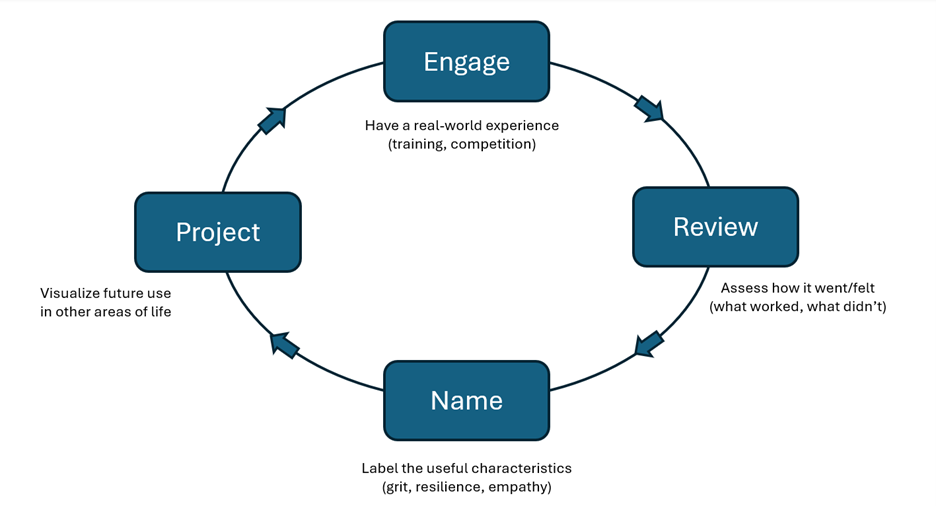
Helpful approaches to incorporating the S.A.I.D. principle in coaching and development efforts appear across the literature, notably in the work of Dr. Martin Seligman, which has proved effective with U.S. Army soldiers.5 In sport coaching, where challenge is not as intense as military service, but ubiquitous, the E.R.N.P model has been used to transfer psychosocial competencies built through sport to real-world experience6 (Fig. 1).
__beyond_strength_summit__w.png)
In the E.R.N.P. framework, the Engage stage requires active participation in challenging experiences, recognizing that certain abilities cannot be cultivated through theory alone. The Review stage calls for deliberate reflection on outcomes and emotions (“what happened? how did it feel?”). This puts situations in context, creating an aligned inner narrative while entrenching the emotional regulation and resilience needed for high-pressure situations.7 It is then helpful to Name (label, in one’s own words) psychosocial skills like grit, empathy, and resilience that underpinned the performance. This stage of the strategy exists to empower, build confidence, and increase the future use of similar skills8; “I’ve shown resilience before, I can do it again.” Finally, Project encourages visualization and intentional imagery to transfer those skills into other domains. For example, if someone demonstrates “resilience” while training hard for a sport, they might imagine themselves studying hard during final exams or during a tough stretch at a new job. This approach can, of course, extend to a myriad of challenging life circumstances. The Project phase is not a novel concept, as motor imagery has been shown to activate neural pathways aligned with those engaged during physical execution.9,10 Similarly, intention-setting has been shown to prime prefrontal goal-directed networks.11,12 It has been suggested that the cycle (E.R.N.P) might be helpful in supporting people into and through challenging experiences, as well as improve their confidence and degree of self-appreciation.6
Without engagement, the cycle has nothing to build on. Growth, empowerment, agency, self-determination, and confidence cannot be built in theory alone. These capacities require experience. Common as avoidance may be – and as effective as it may be in avoiding potentially painful situations – at scale, this pattern might carry public health implications. Chronic stress, social isolation, and limited growth do not emerge in isolation. They cluster. And they map onto mental health concerns.13,14 If default avoidance contributes to these patterns, it deserves examination not only as a psychological phenomenon, but as a population-level concern.
Meanwhile, psychological flexibility, its counterbalance, predicts mental health across a wide range of populations.15 Psychological flexibility, cognitive behavioral therapy (CBT) and other methods of improving resilience and wellness in the presence of stress are not possible without first acknowledging that a concern exists.16,17 Default avoidance is the concern. Denial is its ally. They can be difficult to recognize, but it is worth doing so. Awareness is the first step.
Avoidance and Internalizing Disorders
Challenge is a part of life. The challenge of gravity creates skeletal and muscular strength. The challenge of sounding out words eventually prepares one to read. Challenge is not something to be avoided. Experiential avoidance is associated with anxiety disorders, depression, posttraumatic stress symptoms, and substance use disorders.18,19 Meta-analytic studies indicate that psychological inflexibility, characterized by rigid avoidance of internal experience, predicts greater symptom severity across many categories.15
In the presence of potential stressors, emotion regulation can be distinguished from emotion avoidance.20 While emotion regulation is a valuable strategy, emotion suppression, a specific form of avoidance, has notable consequences. People who habitually suppress emotions, rather than recognize and regulate them, report lower social support and decreased satisfaction in relationships.21 In these situations, those who habitually suppress emotions might also become frustrated that they cannot connect with others – others who, as a byproduct of the suppression, find it difficult to truly understand the person in need of support. And while emotions are tamped down, the physiological strain that accompanies them – whether acknowledged or suppressed – remains (the splinter is still stuck in the palm). In experimental settings, suppression increased sympathetic nervous system activation compared to those who engaged in the more adaptive strategy of acknowledgement and cognitive reappraisal.7
Avoidance, therefore, might reduce the outward display of stress symptoms without reducing distress itself. It is like sweeping dirt under the rug. The dirt, the concern, is still there. And in the case of unprocessed psychological concern, it can pressurize. Unaddressed, chronic activation of stress systems can contribute to allostatic load – the burden placed on regulatory systems like the autonomic nervous system (involuntary processes such as heart rate, blood pressure, and respiration), the endocrine system, and the hypothalamic–pituitary–adrenal (HPA) axis (which governs the hormonal stress response in alignment with the hypothalamus, pituitary gland, and adrenal glands).22–24 As allostatic load rises, other processes adjust alongside it, all in support of keeping the body alive during times of challenge and distress. The under-the-surface ripple effect includes elevated cortisol, increased inflammatory markers such as cytokines,25,26 and autonomic dysregulation.22,27 In longitudinal studies, these issues predict greater cardiovascular risk and an increased likelihood of negative health outcomes.28 The biological mechanism is complicated, but not mystical – when stress is not processed, it is carried, whether one is willing to acknowledge it or not. The rug might hide the dirt, but it does not remove it.
Compounding this phenomenon, as technology improves, screen time has increased.29 When distress shows up, pleasant distraction is immediate and accessible. Social media use, particularly when driven by escape motives, correlates with increased isolation and depressive symptoms.30 While digital platforms give the illusion of connection, passive and continuous consumption of them is associated with decline in well-being.31 Addiction has long been associated with avoidance. Drinking, smoking, and gambling have been associated with the desire to escape uncomfortable emotions.32 Screen use, it seems, is a more socially acceptable version of a similar effort.
All of this can create a maladaptive cycle of thought, emotion, and behavior. Avoidance of challenging social situations limits social bandwidth over time, (just as a marathoner loses fitness by avoiding the challenge of training). That loss of bandwidth reduces opportunities for corrective relational experiences; if one is afraid of conflict, so they avoid conflict, they are missing out on opportunities to manage conflict in a healthy way. The marathoner who avoids training misses the opportunity to collect positive training experiences. Without real world proof that they can get through a challenging experience, they might retreat further. They might isolate. Isolation intensifies vulnerability to both mental and physical illness.33 In avoiding challenging conversations and stressful situations, they degrade their ability and decrease their confidence. In this way, avoidance of pain might exacerbate the risk of deeper pain. In meta-analytic findings, social isolation and loneliness are associated with increased mortality risk comparable to established health behaviors such as smoking.33 Withdrawal reduces opportunities for support. Reduced support amplifies distress, which might reinforce withdrawal. It is a painful and all-too-common cycle.
When avoidance becomes the default setting, it does not necessarily manifest as withdrawal. In some individuals, aggression presents as the byproduct of a similar strategy. That pile of dirt under the rug, that unexamined stress, can pressurize. It can present then as aggression, serving a similar function (create distance from threat). In some cases, depending on one’s personal history, being on the offense can feel like the best defense. Research on emotion regulation and aggression indicates that hostile behavior often emerges from deficits in adaptive emotional processing.34 Longitudinal research suggests that reactive aggression is closely linked to emotion dysregulation and maladaptive coping.35 The offensive maneuver of aggression is still driven by a desire for safety. Rather than slinking into isolation, the individual moves outward – another presentation of the same instinct: avoidance of external stressors and internal discomfort.
When these strategies are normalized, they can create impact at the community level. Normalization of either withdrawal or aggression chips away at communal trust. Trust is a predictor of community health outcomes, including adherence to public health recommendations and collective efficacy.36 When denial and avoidance become cultural norms, the consequences compound.
An Approach to Healing
Denial and avoidance are built through experience. Trauma exposure, chronic stress, insecure attachment, and modeled behaviors (most often via parents or threatening local environment) will shape individual coping strategies. Research in developmental psychopathology demonstrates that early adversity predicts both internalizing and externalizing coping patterns later in life.37 What begins as an adaptation to instability, when it goes unconsidered, can create rigidity even in stable future environments. But it is trainable. People can change.
The aim of public health efforts should not be to eliminate discomfort. Discomfort is inevitable and, in the conversation of growth and adaptability, it is essential. The focus should be on engaging with challenge in a healthy and empowering manner, thereby minimizing the tendencies of denial and avoidance.
To be clear, this is not a call for people to be more confrontational. When engaging with potential stressors, a deep toolkit will build that includes empathy, listening skills, and adaptability. Those skills cannot be built in concept alone. While mental preparation is important, actual engagement is needed. Exposure therapy, which is blended with CBT and requires engagement, continues to be one of the most effective therapeutic interventions.38,39 Avoidance impedes the ability to develop the skills it takes to engage.
A comprehensive solution to this concern must not be overly prescriptive, since each individual has developed dispositions and strategies aligned with their own unique experience. One size will not fit all – what worked for “Michael” might not work for “Michelle.” It might be most appropriate to begin with a conceptual approach, then funnel toward specific interventions in context-specific ways, with onus on local efforts with high degrees of insight on environmental context. This three-step response offers a potential starting point.
Cultural Destigmatization of Vulnerability
Psychological flexibility increases when emotional disclosure and vulnerability are socially reinforced rather than stigmatized or punished. Self-compassion research demonstrates that individuals who honestly acknowledge their own distress, without judgment, exhibit greater resilience.40 Leaders who model emotional honesty have the power to shift norms. Cultural scripts that equate vulnerability with weakness reinforce avoidance – those scripts, or mindsets, are antiquated and have to go. Scripts that frame openness and, yes, vulnerability, as a step toward strength can expand behavioral options.
Public health campaigns have reshaped norms around health behaviors before. More people wear seatbelts. Fewer people smoke cigarettes. National and local initiatives have started focusing on safer social-media engagement. Now, we need more strong voices supporting the ideas that one can be both strong and vulnerable, competitive and caring, stoic in moments, but honest about challenges along the way.41 It is certainly possible, if it is prioritized.
Create Greater Access to Interventions that Increase Flexibility
Acceptance and Commitment Therapy, and related approaches, directly target experiential avoidance by cultivating willingness to experience internal states while pursuing valued action.18 This approach has demonstrated a positive impact across anxiety, depression, and chronic pain populations. It allows people to get into the arena of life, which is the only place true confidence can be gained. The arena of life can be unpredictable, so psychological flexibility remains an important factor across wellness outcomes.15 When individuals learn to notice distress without reflexively moving away from it, stress-fueled reactivity can decrease. With less reactivity, people stand a chance of being responsive and selecting from a wider range of behaviors.
The problem is that these strategies are not often taught until additional support is needed. That is, learned in a therapist’s office, with a professional coach, or through an individualized education plan (IEP). It would be wise to integrate similar approaches into primary care settings, more widely through educational systems, within athletic programs, and in workplaces. These are true “life skills” and should be universally understood.
Important to note that this is a key component of health equity; while some can afford trained therapists, personal coaches, or programs that utilize E.R.N.P. and other trauma-informed strategies, these interventions are not universally accessible. The reach of these types of support should be broadened, and not limited to communities with resources.
Promotion of Physical Health and Wellness
It would be negligent, in this discussion, to forget that mind and body are inextricably connected. They are one in the same. Healthy life choices can provide a physiological foundation that strengthens the ability to tolerate distress. Creating adequate sleep opportunities, prioritizing regular exercise, and adopting quality nutrition habits can support systems involved in stress and emotion regulation. When these systems function well, individuals might be more capable of maintaining emotional stability and cognitive control during difficult experiences.24,42
Sleep improves emotional regulation and recovery from stressors. Physical activity can reduce anxiety and improve mood regulation. Stable nutrition can support brain energy and cognitive function. While healthy behaviors do not remove distress, they can expand the body’s capacity to experience stress without becoming overwhelmed.43,44 No one is at their best when sedentary, malnourished, and sleep deprived. This too requires a discussion of health equity, since quality food and optimal sleep conditions are not available to all. The continued promotion of physical health and wellness would include alignment with understanding, motivation, and access across communities.
Moving Forward
Mental health concerns are on the rise.45 There are countless well-intentioned initiatives aimed at addressing this concern. A public health framework that includes avoidance as a legitimate concern would be an important step forward.
Many initiatives have aimed at alleviating the symptoms of stress. They are important. Support animals are amazing. Lighting a candle and taking a bubble bath can be fantastic, now and then. Eventually, it becomes clear that symptom mitigation is not as impactful as supporting people at the root of the concern. Uprooting avoidant tendencies might include cultivating cultures that normalize vulnerability rather than ridicule it. It would make sense to widen access to therapeutic approaches that increase resilience and psychological flexibility (those skills should not be taught exclusively in therapist offices). And a general appreciation for physical health can both expand distress tolerance and empower people through small successes, making all interactions feel just a bit better.
Humans are programmed to be wary of threat. At times, avoiding threat makes perfect sense. But when avoidance becomes a default setting, stress-induced health issues rise, and opportunities to engage, learn, and grow are missed. If health and empowerment are benefits to public health, there should be increased efforts to support people with the ability to confront stressors in a healthy way, not avoid them. The insights here provide a conceptual beginning to this discussion, rather than a comprehensive approach to its solution. Initiatives should be individualized and context specific. No solution is possible without confronting the concern. Pull the splinter out. Avoidance can keep one safe for a moment, but healthy engagement can empower people for a lifetime.