
Note
Throughout this paper, we will be employing the following terminology with the intent to be inclusive to all individuals regardless of sexual or gender orientation. Latine is a gender-neutral form of the term Latino/Latina utilized rather than Latinx because of the reasons discussed by Villanueva Alarcón et al. in an editorial published in 2022.1 The term queer and Lesbian, Gay, Bisexual, Trans, and Queer or Questioning with the plus symbol to represent other sexual/gender identities (LGBTQ+) will be utilized per the terminology defined by the Human Rights Campaign.2
Introduction
Latin American culture emphasizes the importance of family and kinship in survival and belonging – and yet – many LGBTQ+ youth report they do not feel this sense of belonging. In ‘traditional’ Latine culture, familismo is the need to put family members and collective needs above that of the individual and machismo is a cultural construct focused on hypermasculinity.3–5
Latin American culture influences experiences of LGBTQ+ Latine youth in the US, as exemplified by testimonies of queer Latine American youth. Laya Monaez, a DC-based trans artist and activist, described
“When I came out as a transgender woman, my father felt I was going against his religion, machismo and family legacy, so he disowned me for five years. Eventually, my older sisters told my father that they would no longer attend Christmas gatherings if I wasn’t invited. They used the idea of familismo to unite the family again, reminding my dad that family means nobody should get left behind”.6
Culture can enrich one’s existence but can also perpetuate traditional ideals that prevent individuals from being their true selves. Furthermore, culture can influence one’s perception of gender and sexuality: Latine culture enforces heteronormativity, characterized by “norms, discourses, constructs heterosexuality as natural and superior to all other expressions of sexuality”.7,8 This concept poses a threat to the health of queer Latine youth as it leads to homophobia.9 In addition, various forms of sexual stigma may lead to physical threats or overt violence and hate crimes.10–12 Another form of stigma, familial rejection, may arise due to familismo – ranging from microaggressions to further violence.13,14 A lack of familial acceptance can also contribute to internalized sexual stigma and lead to lack of self-expression whilst simultaneously evoking internalized homophobia and further perpetuating health disparities.15
Latine individuals as well as LGBTQ+ individuals face unique challenges, and the intersection of these marginalized identities pose additional layers of discrimination and hardship during upbringing.16 In the intersectional lens, carrying multiple marginalized identities can have compounding influences on Latine LGBTQ+ mental and physical health, as demonstrated through Latine LGBTQ+ individuals facing a higher burden of physical and emotional health challenges in comparison to their non-Latine or queer counterparts.17,18 Additionally, socioeconomic status may influence personal and structural barriers to healthcare reflecting social disadvantage and systemic discrimination which many LGBTQ+ persons experience. This may also be due to social and medical attitudes toward sexuality and gender identity.19
With growing populations of both Latine American and LGBTQ+ persons in the US, understanding their unique intersectional health needs is increasingly important.20 Given the limited research in this area, our primary objective was to identify key patterns, themes, and gaps in the existing literature to create a causal loop diagram (CLD) and capture the complexity of these experiences. Our review aims to explore components of Latin American culture and their roles in the lived experiences of queer Latine persons of the US.
Methods
We conducted a non-systematic literature review to examine what factors shape Latine LGBTQ+ sexual health and wellbeing. Initial searches were conducted to identify high-quality, peer-reviewed studies, reports, and scholarly articles using keywords, including but not limited to: machismo, familismo, patriarchal norms, familial acceptance, Latine LGBTQ+ self-perception, homophobia, and heteronormativity, with a particular focus on LGBTQ+ identities. Our review includes 22 peer-reviewed articles. This project did not include the collection of novel data or utilization of secondary data sets but rather culminates the findings of existent research articles and thus was exempt from university ethics.
To explore relationships among the various factors influencing queer Latine health, we generated a CLD using Vensim Software. We then identified feedback loops to highlight the complex and intersecting dynamics and explore potential areas for future research and interventions. Visual interconnectedness also supports a holistic approach, enabling the development of complex and effective intervention programs.
Results
Family Acceptance
Family acceptance was a key determinant of self-perception of queer Latine persons. Rejection from family, motivated by cultural norms such as heteronormativity and familismo, often resulted in individuals hiding their true identities to maintain their familial relationships.7,21 We identified that family rejection was linked to lower self-perception, with many queer Latine persons avoiding sexual orientation disclosure to avoid judgment or conflict, and was also linked to mental illness such as depression and/or anxiety.21,22 Rejection, even during adolescent years, is linked to significantly higher likelihoods of attempted suicide, severe depression, condomless sex and illicit substance use in adulthood and in the US. Conversely, familial warmth/perceived closeness and acts of love/affection are necessary protective factors for adolescents and linked to greater self-esteem.13 Family relationships are complex, however, and familial warmth and rejection are not mutually exclusive. Lack of family acceptance contributes to internalized homophobia; many queer Latine people often internalize harmful negative views an attempt to maintain positive family dynamics.23 Ultimately, this highlights the importance of fostering healthy family dynamics to support LGBTQ+ individuals.
Religion
Religion further influences homophobia in queer people. People with higher religiosity often feel more disconnected from their LGBTQ+ identities, resulting in increased marginalization and decreased self-expression.24 Among a sample of lesbian women, gay men, and bisexual individuals, Latine people experienced more internalized homophobia compared to non-Latine participants, in particular due to exposure to religion.25 Gender minority identifying individuals report religious experiences as restrictive and confining.26 In effect, religion may perpetuate internal conflict and exclusion affecting the well-being and self-acceptance of queer Latine communities.
Heteronormativity
Heteronormativity can reinforce norms and impact identity development. In fact, heteronormative pressures increase internalized homophobia as individuals have difficulty connecting their cultural upbringing with their true gender identity or sexual orientation.7 Additionally, heteronormativity often leads to queer people entering heteronormative relationships to avoid societal rejection.3 Latine men in particular often hide their same-sex relationships and are often down low (DL) to uphold public heteronormative standards, decreasing individuality and access to communities or care.27
Traditional Latin Culture and Machismo
Machismo discourages vulnerability, reinforcing the notions of hypermasculinity that isolate LGBTQ+ individuals from support networks. People experiencing internalized homophobia due to the cultural stigma around masculinity, experience lower self-esteem and increased mental health struggles.28 Latine trans and nonbinary individuals identify feeling alienated as a result of machismo and Latin gender norms.26 In addition*,* machismo intersects with other systemic issues. Queer Latin American men often experience poverty, engage in higher risk sexual practices, and face psychological distress at higher rates in society.29 Traditional machismo or emotional attractiveness and dominance also can perpetuate mental illness, internalized homophobia and prejudice towards other queer people.30
Individuality and Self-Expression
Individuality and self-expression are tied to family dynamics and cultural expectations; people often hide identities to fit in with family expectations, which can result in lower self-esteem and poorer mental health.22 Lack of self-expression may also be the result of oppression and discrimination, which are reoccurring themes in interviews with Latine transgender individuals and particularly salient topics given the high risk of violence within this population.31–33 Concealment strategies reflect fear of judgment or rejection from family and society, diminishing individuality. Non-traditional support systems are critical when family acceptance is absent, with many genderqueer or nonbinary Latine youth relying on chosen family and/or community networks to navigate rejection and rebuild individuality.34 Additionally, art and artistic expression positively influence resilience and self-perception, being described as a form of authentic self-expression and coping mechanism for emotions of rejection and shame.35 Social media, although potentially harmful for mental health in some contexts, can provide opportunities for social support and self-expression.36
Causal Loop Diagram (CLD)
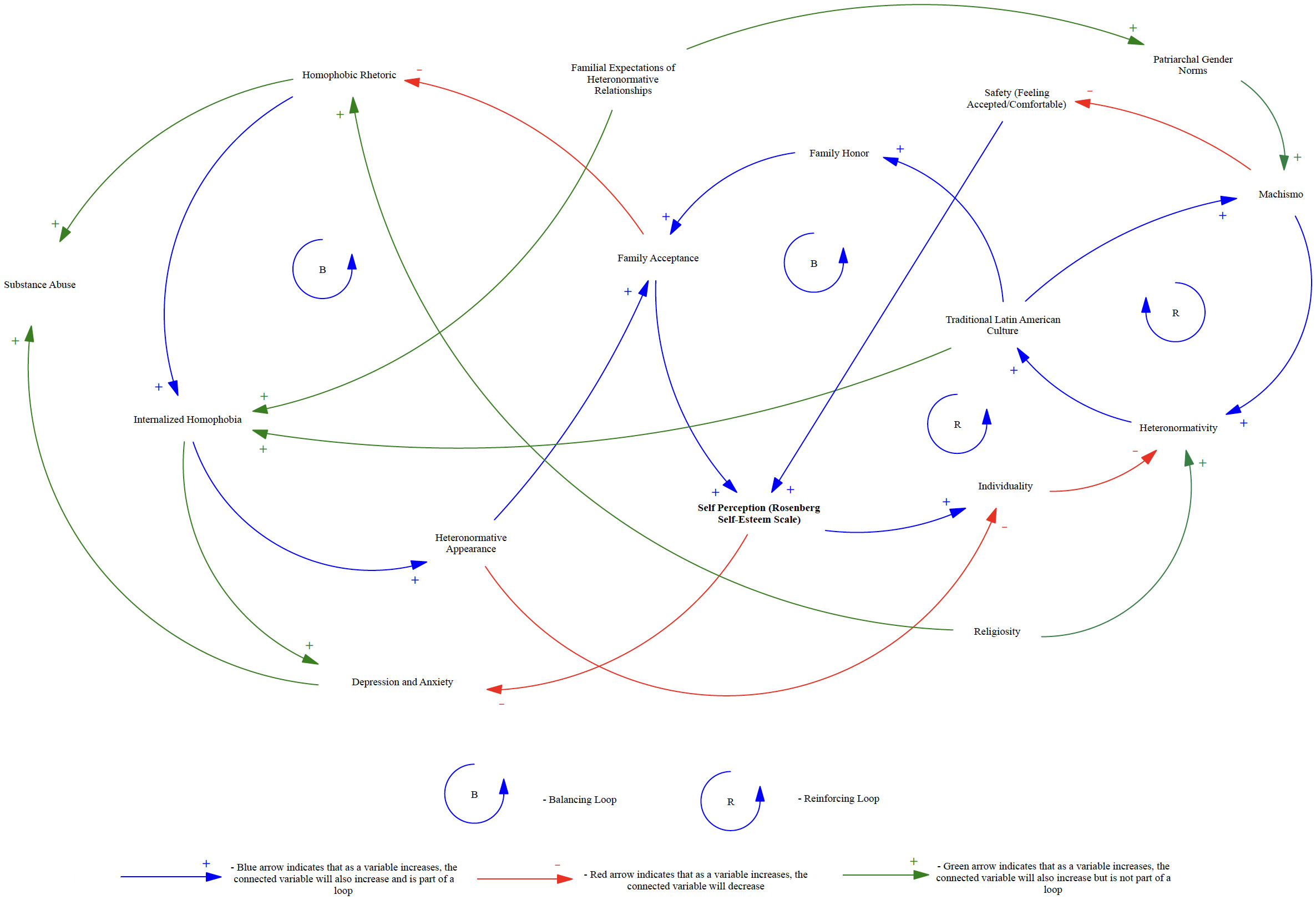
The CLD in Figure 1 illustrates the complex relationships social determinants of health and culture. Key positive (+) associations between each factor can be depicted by blue arrows in our diagram while the red arrows indicate a negative (-) association between variables. Green arrows demonstrate the additional factors that are not part of our major loops and are accompanied by a direction of association (+) or (-). These positive and negative associations contribute to feedback loops that outline how the system behaves. Reinforcing (positive) feedback loops amplify change within the system and are defined by all positive arrows or an even number of negative arrows.37 Positive reinforcing loops produce virtuous cycles while negative reinforcing loops produce vicious cycles.37 Conversely, (negative) feedback loops generate forces of resistance that ultimately limit growth and promote equilibrium through the maintenance of stability; they are defined by an uneven number of negative arrows within a loop of the CLD.37 Our CLD provides a visual representation of our findings as presented in our results and elucidates the interconnectedness of each of our variables.

Discussion
In Latine communities in the US and elsewhere around the globe, traditional values often enforce restrictive gender roles that exacerbate the challenges faced by LGBTQ+ individuals. The pressure to conform to societal norms to preserve familial reputation and avoid social rejection creates a constant dynamic for Latine LGBTQ+ individuals. Societal norms and religion often shape perceptions of gender and sexuality, with heteronormative expectations in Latine communities prompting individuals to suppress their LGBTQ+ identities. Cultural values and family create strong pressures to conform to heterosexual norms. The tension arising from familial expectations and sexual identity often compels LGBTQ+ individuals into relationships that do not represent their true selves, resulting in emotional distress and lowered self-esteem.3
As discussed, family rejection, often driven by cultural norms of heteronormativity and family values, can create a cycle of shame, self-suppression, and poor mental health outcomes. Family-based interventions can reduce the effects of familial rejection: structured programs enhancing cultural sensitivity and open communication can increase family acceptance and foster greater self-expression and individuality among LGBTQ+ youth while simultaneously reducing internalized homophobia and shame.38 Ultimately, these factors shape how Latine LGBTQ+ individuals understand their identity and respond to societal norms.
The CLD provides visual representation of the complex and nuanced intersection of cultural influences and components that dictate the lived experiences of Latine LGBTQ+ individuals. The interconnectedness of relevant cultural elements creates a mixture of reinforcing and balancing loops that may improve or worsen a person’s view of themself. These factors differ in importance and pervasiveness for each queer Latine individual, thus producing distinct individual experiences with self-perception.
Addressing these issues requires disrupting patterns of familial rejection, internalized negative self-perception, and identity suppression. Culturally aware initiatives that promote family acceptance are crucial in mitigating the harmful effects of familial rejection on self-esteem.38 Educational initiatives and awareness campaigns can challenge religious and cultural norms to reduce stigma within Latine communities. By fostering more and inclusive beliefs, these programs have the potential to reduce the social exclusion experienced by LGBTQ+ individuals.24
A promising example is the Familias con Orgullo intervention, which addresses substance use, sexual health, and depression among Latine sexual and gender minority youth.38 Its strength lies in a culturally sensitive approach that leverages positive traditional values like familismo to counter challenges stemming from cultural factors like machismo.38 By engaging both parents and adolescents in tailored educational discussion sessions, the intervention fosters open communication, mutual understanding, and respect.38 Utilizing existing cultural values, it positions parents as agents of change, helping them recognize how traditional norms contribute to stigma and discrimination.
In addition, Participatory Culture-Specific Intervention Modeling (PCSIM) offers a valuable framework for families to learn how to support their LGBTQ+ children.39 Researchers applied this model to develop a two-hour conversational session designed to create an interactive and safe space for mothers of LGBTQ+ children to learn about the community, ask questions, and address myths and misconceptions.39 The session covered topics such as the grief and denial parents may experience when children come out, basic LGBTQ+ terminology, and more complex concepts like minority stress theory and its role in shaping health disparities.39 Beyond education, this approach provided parents with reassurance and guidance on fostering open communication, affirmation, and expressions of love – especially for those struggling with uncertainty.39 In Latine communities, interventions like Familias con Orgullo also incorporate discussions on religion, familismo, and machismo, highlighting their influence on parental attitudes and optimizing support for LGBTQ+ children.39
Beyond intensive intervention models, film-based approaches can also support parents of LGBTQ+ youth. “Lead with Love,” a film designed to provide comfort, information, and behavioral guidance for parents of LGBTQ+ adolescents, aimed to reduce rejecting behaviors and foster positive family environments.40 While a more passive approach, its online accessibility allows for a broader reach, offering parents a confidential and anonymous way to engage with the material.40 This film serves as a valuable resource, equipping parents with emotional support, information, and actionable strategies for responding to a child’s coming out, with over 70% of parents who viewed the film found it “very” or “extremely” helpful.40
Another potential strategy that would serve as a culturally responsive adaptation of the film-based approach is the use of telenovela-based interventions. Telenovelas, a form of soap operas, are a powerful component of Latin American culture.41,42 Reports have noted that some find their family dynamics are deepened and maintained by the collective experience of being telenovela viewers.43 The successful utilization of telenovelas in recent health interventions for issues such as mental health and domestic violence suggest the possible benefit for families of queer identifying individuals.44 Telenovela-based interventions may be capable of challenging assumptions and biases about queer identities along with improving attitudes, beliefs, awareness, and LGBTQ+ competence among viewers.
While family-centered interventions represent a source of progress, they remain scarce, particularly for ethnic and racial minorities. Familias con Orgullo is one of the few tailored programs for Latine LGBTQ+ youth., whereas Leading with Love takes a broader approach that overlooks the impact of intersecting identities on lived experiences. Telenovelas have demonstrated to be promising as a mode of education to assist Latine populations in health promotion and disease prevention, with implications in encouraging familial allyship for LGBTQ+ individuals. Another concern is engagement and reach: intensive programs may have limited impact, often attracting families that may already be more accepting, thus failing to reach those who might benefit most. Conversely, broader film-based interventions may be less effective due to their passive nature, requiring minimal participation, engagement, and reflection. Given these limitations, continued research is essential to evaluate the efficacy of these interventions, identify their most impactful components, and expand access to culturally responsive programs.
Limitations
The non-systematic review offered significant insights into the factors influencing the self-perception of Latine LGBTQ+ individuals; however, it also presented certain limitations. Firstly, the review is based on a limited selection of publications due to the specificity of the topic. Existing literature remains limited and does not fully capture the diversity of perspectives and experiences within queer Latine communities. This observation becomes particularly clear when analyzing the differences in nativity between individuals born in the U.S versus those born elsewhere. Nativity can be a major identity-shaping factor, particularly for foreign-born Latine LGBTQ+ individuals who frequently face unique challenges associated with cultural adaptation, legal status, and language barriers. The presence of these factors leads to distinct lived experiences when compared with those of individuals born in the United States.45 Furthermore, the cultural norms established by an individual’s country of origin play a significant role in shaping self-perception. For instance, individuals identifying as LGBTQ+ in Spain, a country where LGBTQ+ rights are generally accepted, might experience identity formation differently compared to their equivalents in Mexico, where current religious and societal norms still significantly influence perceptions of gender and sexual diversity.46 Moreover, the prevalence of stigma continues to act as a significant barrier that impacts participation in research studies. Numerous individuals, especially people from conservative or marginalized communities, often demonstrate unwillingness to expose their identities and/or experiences, primarily driven by concerns regarding potential discrimination or the possibility of familial rejection. This resistance leads to sampling bias, as research may disproportionately include individuals who feel more secure participating in academic studies, while simultaneously neglecting those who encounter significant obstacles to acceptance and visibility.47 Consequently, some narratives may receive greater emphasis, while others may be neglected, thereby limiting a complete understanding of the Latine LGBTQ+ experience. It must additionally be noted that individuals apart of the LGBTQ+ community are faced with varied life experiences, thus combining those of differing sexual orientations and gender identities serves as a limitation in understanding the nuanced, unique experiences faced by queer populations. Finally, this study is centered on the US, making it difficult to apply these findings to other regions. Patterns of identity formation, experiences of discrimination, and levels of community support can have considerable variations between Latin America and the U.S., and these differences are influenced by distinct sociopolitical frameworks, cultural perspectives, and legal safeguards available to LGBTQ+ individuals in these regions. Because of these variations, future research should prioritize integration of cross-cultural comparisons to offer a more comprehensive and precise depiction of Latine LGBTQ+ identities within various geopolitical and sociocultural contexts.20
Conclusion
The self-perception of Latine LGBTQ+ individuals is significantly influenced by cultural and familial dynamics, particularly with regards to family acceptance, heteronormativity, and patriarchal values. This study highlights the significance of altering the feedback mechanisms established by societal expectations to conform to heteronormative standards. Approaches designed to promote familial acceptance, minimize stigma within religious and cultural groups, and develop chosen families may effectively reduce the adverse consequences associated with familial rejection and cultural marginalization. This study highlights the importance of implementing interventions that are culturally aware and comprehensive, considering the complex relationships of family, culture, and identity. By breaking the destructive cycles of rejection and self-suppression, we can support Latine LGBTQ+ individuals achieve a sense of self-worth and acceptance. Further investigation and policy measures are essential to improve the mental health and well-being of Latine LGBTQ+ individuals, particularly in relation to the cultural and familial factors that shape their self-perception. The insights established through this search contribute to the awareness of the relationship between cultural identity and the experiences of LGBTQ+ individuals. By developing targeted interventions that recognize the significance of family and cultural values, we can work towards creating more welcoming environments for queer Latine individuals in the US and around the world.
Acknowledgments
We would like to acknowledge the Johns Hopkins University Public Health Studies Program.
Disclosure Statements
The author(s) have no relevant financial disclosures or conflicts of interest.
Figures and Tables
Figure 1. Causal Loop Diagram for The Influence of Culture and Family on Queer Latine People in the US
Author Biographies
Corina Mills is an undergraduate pre-medical student at Johns Hopkins University double-majoring in Public Health Studies and Natural Sciences. She is involved in a variety of Latine health advocacy and civic engagement projects in and around Baltimore, MD. Her research interests lie in environmental, place-based, and racial health disparities.
Kevin Vazquez is an undergraduate student and researcher at Johns Hopkins University, pursuing a double major in Molecular and Cellular Biology and Public Health. His research interests include environmental health, asthma, and health disparities.
Julisa Cortes is an undergraduate student at Johns Hopkins University double-majoring in Public Health Studies and Sociology on the pre-medicine track. Her research interests include cultural competency in mental health care and health disparities in immigrant and Spanish-speaking communities.
Emma Shukla is an undergraduate student at Johns Hopkins University majoring in Public Health Studies with minors in Spanish Language and Hispanic Culture and Women, Gender, and Sexuality. Her research interests focus on reproductive and sexual health equity, with an emphasis on Latine and gender-diverse populations.
Tom Carpino is a Gordis Faculty Teaching Fellow at the Johns Hopkins University Bloomberg School of Public Health and postdoctoral researcher at Duke Global Health Institute. His primary research interests include social and behavioral epidemiology.
Author Positionality
Corina Mills is a current undergraduate senior studying public health and natural science at Johns Hopkins University and is enrolled in the environmental health bachelors/masters program at Johns Hopkins Bloomberg School of Public Health. As a health disparities researcher and Hispanic American, Corina’s engagement in this project, stemming from the course Sex and Syndemics, results from personal interests and professional pursuits.
Kevin Vazquez is a current undergraduate junior studying public health and molecular/cellular biology at Johns Hopkins University. As a Mexican-American and aspiring physician, Kevin’s contribution to this project is motivated by personal experience and desire to advocate for the LGBTQ+ Latine community by highlighting cultural upbringing issues to decrease health disparities. His involvement in the project was also driven by his academic and professional aspirations.
Julisa Cortes is a current undergraduate senior studying Public Health and Sociology at Johns Hopkins University. Given her Mexican-American background, Julisa hopes to continue advocating for the Latine community in the United States by addressing healthcare disparities shaped by language barriers, systemic inequities, and cultural stigmas surrounding types of care. Through community-based research and volunteering as a Spanish speaker, Julisa seeks to bridge the gap between underserved populations and culturally competent care.
Emma Shukla is an undergraduate junior at Johns Hopkins University, studying Public Health Studies with minors in Spanish Language and Hispanic Culture, and Women, Gender, and Sexuality. As a Colombian American woman and researcher, her contributions to this project are shaped by her academic background and commitment to advancing health equity for Latine and gender-diverse communities, motivating her to continue her studies through a master’s program focused on sexual and reproductive health research.
Tom Carpino is a faculty teaching fellow at Johns Hopkins University Bloomberg School of Public Health, and postdoctoral infectious disease fellow at Duke University Global Health Institute. As an individual personally affected by various forms of stigma and marginalization, their scholarship is grounded in lived experiences yet strives to remain unbiased and neutral in all of his research.