
Introduction
Healthcare systems continuously face the burden of mental health conditions, yet access to care remains significantly inequitable across the globe. In any given calendar year, it is estimated that more than one in five adults in the U.S. (which is approximately 59.3 million people) live with mental illness. In contrast, the World Health Organization estimates more than one billion people globally live with mental illness.1–3 Indeed, discussions around the awareness of mental health have increased exponentially in recent times, yet structural vulnerabilities prevent many individuals from getting affordable, culturally responsive, and timely care. Median government spending worldwide allocates only 2% to mental health.2 Mental health inequity goes beyond receiving a mental health diagnosis to include unequal access to treatment, resources for prevention, dignity, safety, and the necessary support for long-term recovery. These vulnerabilities are usually a result of social determinants of health such as race, status, ethnicity, housing, stigma, geographic location, insurance, and systemic discrimination.3 Accordingly, mental health outcomes are influenced less by individual biological predisposition and often impacted by structural conditions that determine whether an individual can have access to care that is meaningful and affordable.3
Throughout generations, marginalized communities such as persons of color, immigrants, rural populations, low-income families, indigenous populations, persons with disabilities, and sexual/gender minority individuals experience uneven vulnerabilities to utilizing mental healthcare and continuity of care.3 Financial instability, lack of insurance coverage, provider shortages, long wait times, culturally incongruent treatment models, and transportation barriers further exacerbate these inequities.4
These systemic and structural barriers to care extend into how communities respond to behavioral health emergencies. Crisis response systems in many communities continuously depend on interventions from law enforcement rather than trauma-informed approaches.4 This reliance can turn an encounter that calls for clinical stabilization into one that presents an elevated risk of harm or criminalization, especially for communities that already express low confidence in institutional structures. Reforming crisis response is therefore not a core test of whether public health systems treat mental health emergencies as health emergencies.
Mental healthcare in the United States and beyond remains reactive rather than proactive and preventive, despite increased public awareness and education on behavioral challenges.3 Emergency response systems are usually prioritized at the national level, while wellness interventions such as affordable housing, trauma-informed education, economic security, and community-based prevention programs that support long-term wellness are often underfunded.3,5 Workforce data alone demonstrates this imbalance; as of the latter part of 2025, the Health Resources and Services Administration (HRSA) identified more than 4200 rural Mental Health Professional Shortage Areas across the nation, and bridging those gaps would require close to 1800 extra practitioners, a scarcity which disproportionately affects the communities that also lack infrastructure for crisis and prevention.5
This paper argues that mental health inequity requires structural reform, as it is a vital public health crisis. It emphasizes three public health shifts and priorities: building a culturally competent workforce, integrating mental healthcare across all aspects of the community, and moving toward prevention-centered systems rather than crisis-based care models. This viewpoint is informed by a narrative review of peer-reviewed literature, with sections interpreted as thematic priorities for reform rather than as empirical evidence.
Methods
A narrative review of peer-reviewed literature identified through Google Scholar, PsycINFO, and PubMed used the following search terms: community-based mental healthcare, mental health inequity, social determinants of health, behavioral health disparities, adverse childhood experiences, LGBTQ+ mental health, and culturally responsive care. This was done to explore the various structural determinants of mental health inequity and analyze evidence-based reform practices. The search was limited to sources between 2003 and 2026, a range selected to capture the period following the expansion of the US Surgeon General’s public mental health reporting and to include the most recent, post-pandemic literature on access and telehealth. Program reports and documents that informed policies from federal agencies were also reviewed. One such document was a report from the Substance Abuse and Mental Health Services Administration (SAMHSA). All sources were considered based on relevance to the following reform domains: culturally responsive personnel development, community-based mental healthcare infrastructure, and prevention-based care models. Sources were excluded if they addressed clinical treatment of mental illness at the individual level without reference to systemic or structural determinants, if they were in languages other than English, and if they included advocacy materials or opinions that had no empirical foundation. A sum of twenty-seven sources was examined to support the analysis; excluded sources most typically did not fulfill inclusion criteria because they focused narrowly on individual clinical outcomes rather than structural and community-level determinants, which are the focus of this paper. Table 1 summarizes the sources examined for each reform domain. Given that this paper is a narrative rather than a systematic review, it is aimed at describing how the opinion provided within was informed by the literature.
Defining Mental Health Inequity and the Conditions it Constitutes
As described in this paper, mental health inequity refers to the avoidable, structural differences in the prevention of, access to, and outcomes from behavioral healthcare that are driven by income, geography, race, immigration status, gender identity, or sexuality. The mental health conditions predominantly discussed throughout this paper include post-traumatic stress disorder (PTSD), suicidality, major depressive disorder, and generalized anxiety or other anxiety disorders, which are among the most common mental illnesses diagnosed in the United States.1 The literature well establishes these conditions as associated with the structural determinants described above, including housing instability, poverty, and adverse childhood experiences (ACEs).20,22
Results
The three thematic priorities discussed below were derived directly from the recurring themes identified across the reviewed literature. They are presented as narrative priorities for reform rather than as statistically derived findings, consistent with this paper’s design as a narrative review.
Priority 1: Mental Health Inequity as a Structural Public Health Issue
In order to classify and understand a public health crisis, it is essential to categorize mental health inequity as a systemic public health issue rather than a personal failure or an individual clinical concern. Public health frameworks indicate that determinants such as environmental, political, economic, and social systems influence our health outcomes and quality of life.3 Mental healthcare disparities continue to persist across almost every major indicator of health.3 Severe shortages of mental health providers, especially in rural communities, often result in longer wait times and treatment needs that are mostly unmet.5 Concurrently, ethnic minority and racial populations consistently report less trust in healthcare systems due to racism, historical discrimination, and care that is culturally insensitive.6
Moreover, sexual minority or LGBTQ+ populations also face increased rates of suicidality, depression, anxiety, and trauma exposure while navigating significant vulnerabilities in accessing affirming mental healthcare.11 The Trevor Project’s 2025 national survey of more than 16,000 LGBTQ+ young individuals found that 36 percent had active suicidal thoughts in the previous year and 44 percent of individuals could not access the mental health care they wanted.12 These inequities are exacerbated by stigma within societies, including family rejection, the absence of nondiscrimination protections in insurance coverage, exemption clauses that allow providers to decline the treatment of LGBTQ+ patients, and discriminatory treatment by providers and policies which limit access to inclusive care (such as state bans on gender affirming care for minors).11,12 The Trevor Project’s 2025 report indicated that individuals who resided in less accepting communities attempted suicide at a rate more than a third of that of those in more accepting communities.12 This suggests that identity itself was not the risk factor, but the mistreatment based on the identity that accompanied it.12
Additionally, access to mental healthcare is linked closely to economic instability.7,8 Individuals navigating housing insecurity and poverty in general are susceptible to chronic stressors tied to detrimental behavioral health outcomes.8,20 A systematic review of housing insecurity among renters identified consistent connections with increased depression, psychological distress, and anxiety, impacted by housing instability and the financial burden of housing costs.7 Poverty and depression also mutually affect each other; the risk of anxiety and depression is elevated with poverty, while the mental strain of financial scarcity and the symptoms of depression can hinder economic stability.8 Regardless of this, many individuals living in poverty or housing insecurity remain underinsured or uninsured, which restricts their ability to access psychiatric care, counseling, and other preventative mental health services.7
These patterns indicate that mental health inequities are entrenched within larger systems of social inequality. Structural interventions equipped to improve healthcare and make it affordable, accessible, and representative of individuals are needed to address these inequities.
Community-Based Behavioral Healthcare Infrastructure
Diversifying and scaling mental healthcare delivery into trusted community environments is one critical strategy to reduce mental health inequities. There is a continuous centralization of traditional mental healthcare systems within hospitals, specialty clinics, and private practices, which may be culturally unwelcoming or geographically inaccessible to many communities and populations.3,5
Community-based mental healthcare models aim to decentralize care by integrating these services into churches, workplaces, community centers, and schools. Integrating mental health services into environments that are familiar to people may help reduce societal stigma while also improving access and opportunities for early intervention.
School-Based Programs
For instance, mental health programs within the school systems have demonstrated effectiveness in identifying behavioral concerns among individuals before symptoms develop into a crisis.3
School-based mental health initiatives demonstrate this potential well. Since both adolescents and children spend most of their hours in school, integrating counseling, screening, and psychoeducation within the school systems enables behavioral concerns to be identified and addressed before they deteriorate into crisis.3 A 2023 systematic review of school-based mental health literacy strategies indicated that these programs significantly improved students’ knowledge of mental health conditions and reduced the stigma related to them, both of which were needed for help-seeking behavior.13 Interventions that put together on-site counseling services, mental health education, and clear pathways for referral to community providers demonstrated effectiveness at leveraging heightened awareness into service utilization, especially for students who might be without parental support or transportation to access care off-site.13
Work-Based Mental Health Programs
Mental health programs within work environments offer an alternative pathway for community-based prevention and call for consideration on their own terms. Similar to school-based systems, mental health initiatives within work environments may improve psychological safety, reduce stress and burnout, and promote adult help-seeking behaviors. Organization-led programs that include staff assistance, confidential screening, and manager training in identifying signs of distress have been linked with increased psychological safety and decreased burnout amongst staff.14 A 2023 systematic review and meta-analysis of workplace mental health screening programs found limited yet reliable improvements in help-seeking and user satisfaction. However, the authors indicated that screening alone is insufficient without accessible follow-up care and workplace commitment to addressing the underlying stressors of the organization.14 Therefore, for individuals who may be unlikely to access healthcare routinely, the organization provides an ongoing primary interface where intervention becomes possible.
Telehealth
In rural areas and underserved communities, the extension of telehealth can also create significant opportunities for improving access to needed mental health services.15 Telehealth services significantly improved continuity of treatment during the COVID-19 pandemic.15 It also reduced transportation-related vulnerabilities that had long limited care for clients living far from providers.15 However, technological literacy and internet accessibility (amongst other digital inequities) must be addressed to ensure equitable implementation. Population-specific evidence regarding mental health inequities indicates that these gains were unfairly distributed, as a 2023 national survey identified that rural and low-income black, Latino, and white adults were all substantially less likely than their non-rural, higher-income counterparts to report telehealth access, even though willingness to use telehealth was comparable across groups.15 This finding suggests that along with digital literacy, availability of broadband, and ownership of devices, structural access remains a primary barrier.
The expansion of telehealth also comes with data security and privacy concerns that undermine trust in telehealth. A systematic review of telehealth security risk and privacy factors found environmental barriers such as absence of privacy for vulnerable patients, operational gaps, and limited access to secure connections or devices to be recurring challenges across the literature.16 These negative outcomes are not just abstract, as cybersecurity researchers have identified unencrypted databases containing session recordings and diagnostic information, while regulators have also fined telehealth companies for disseminating patient information to third parties for the purposes of advertisement.16 Populations such as LGBTQ+ individuals tend to navigate a high level of risk when deciding whether to engage with institutional systems due to concerns with identity disclosure, and immigrants concerned about sharing their data with third parties may also avoid treatment-seeking, even when access barriers are otherwise resolved.11,16 Guaranteeing transparent policies on data retention, HIPAA-compliant platforms, and patient education about privacy should occur with any expansion of telehealth infrastructure.
Community-centered mental healthcare systems should be prioritized as public health investments. It is essential to ensure that these systems are equipped to reach communities and populations that have been historically excluded from traditional models of care.
Priority 2: Building a Culturally Responsive Workforce
Representation is not just symbolic but clinically significant within the mental health workforce. Another critical component of mental health equity is culturally responsive care. Patients, clients, and individuals are more likely to engage in treatment when their providers understand their cultural backgrounds, identities, language preferences, and lived experiences.6 According to health services literature, culturally competent care is the ability to deliver care that recognizes and adapts to patients’ diverse values, beliefs, social, and linguistic needs, and to do so at both the individual-provider and organizational level.19
Inadequate workforce diversity persists across many healthcare disciplines such as psychology, counseling, psychiatry, and social work. African American practitioners, for instance, remain significantly underrepresented relative to their share of the population, a disparity related to historical barriers in education, socioeconomic constraints, and mentor or role model scarcity within the field.17 Increasing opportunities for pathway programs, scholarships, and mentorship initiatives for communities and populations that are underserved may strengthen diversity within the workforce while also improving the delivery of culturally competent and responsive care.6
Furthermore, providers should also be required to undergo training in principles of health equity, trauma-informed care, structural competency, and implicit bias. Mental healthcare professionals must understand how adverse childhood experiences, poverty, systemic oppression, and discrimination impact behavioral health outcomes.
Culturally sensitive relationships may improve adherence to treatment, aid the therapeutic relationship, and reduce mistrust among communities and populations that have been historically marginalized and underrepresented. Cultural humility and sensitivity prioritize willingness to learn, ongoing self-reflection, and directly addressing power differences within the therapeutic relationship.18 A 2025 scoping review of cultural humility training in mental health programming found that this orientation was associated with increased provider self-awareness of bias and an enhanced framework for addressing structural barriers to care, indicating that cultural humility can strengthen, as opposed to only replacing, existing competency-based training models.18 It is therefore imperative for public health systems to invest in development programs for service providers, ensuring they are equipped to address the diverse realities of modern populations.
Priority 3: From Crisis Response to Prevention
The United States continues to direct considerable resources toward reacting to mental health emergencies while underinvesting in proactive, preventative interventions that create wellness.3,5 Public health frameworks that are centered on prevention emphasize addressing proactive determinants of mental health before crises arise.
Education on trauma-informed care, stable housing, prevention of violence, food security, community connectedness, economic opportunity, cultural sensitivity training, and cultural competency training are all investments in preventive mental health strategies. These interventions limit exposure to chronic stress while reinforcing protective factors related to psychological resilience.20,21 The impact of this structural intervention intensifies over time and across various systems. For instance, food security and stable housing limit toxic stress responses that form the basis of several behavioral health conditions, allowing individuals (especially children and adolescents) to develop capacity for coping rather than endure sustained psychological stress.20 Social connection reduces isolation, an established factor for depression, suicidality, and substance use, while simultaneously developing community-based support networks that can identify early signs before they escalate to crisis.21 Trauma-informed care and violence prevention education decrease the risk and impact of adverse childhood experiences, which are significantly associated with poor physical and mental health outcomes across age groups.22 Access to economic opportunity alleviates long-term financial burden that exacerbates depressive and anxiety symptoms and improves care access by addressing structural barriers such as insurance coverage and leave from work, which contribute to poverty.8 System-wide, these strategies go beyond addressing individual suffering as they decrease subsequent utilization of healthcare, costs, and help disrupt intergenerational patterns of underinvestment and trauma.24
Public health strategies that are trauma-informed are especially important considering the frequency of adverse childhood experiences and trauma related to chronic stress that coexists with structural neglect in communities.22 Crisis response systems in many communities continue to rely primarily on law enforcement rather than trauma-informed, clinical intervention, which can turn an encounter that calls for stabilization into one that carries an elevated risk of harm or criminalization, particularly for communities that already report low confidence in institutional structures. Expanding trauma-informed, non-police crisis response is therefore central to a prevention-oriented public health strategy, not a peripheral concern. Systems that are prevention-centered acknowledge that most mental health challenges are not isolated individual pathology but rather a response to unstable environments.7,11
Turning the public discourse away from narratives that stigmatize and depict mental illness as a personal failure or weakness is a way of reframing behavioral health through a prevention lens. Systemic accountability, collective responsibility, and community healing should be emphasized in public health messaging.
Ultimately, behavioral healthcare systems that focus on prevention may improve quality of life, reduce rates of hospitalization, and reduce healthcare expenditures, while promoting health equity. In summary, the literature reviewed indicated that mental health inequity is more structural rather than individual. Race, insurance status, poverty, housing instability, and geographic isolation, among other social determinants, are considerably connected with adverse mental health outcomes and limited access to care.3,7 Higher levels of distrust in systems, lower rates of utilization of mental healthcare, and disproportionate exposure to culturally incongruent care are often reported by racial and ethnic minority populations trying to access needed care.6 LGBTQ individuals also face increased rates of anxiety, suicidality, and depression exacerbated by barriers to affirming care and intensified by anti-LGBTQ+ policies in recent times11,12
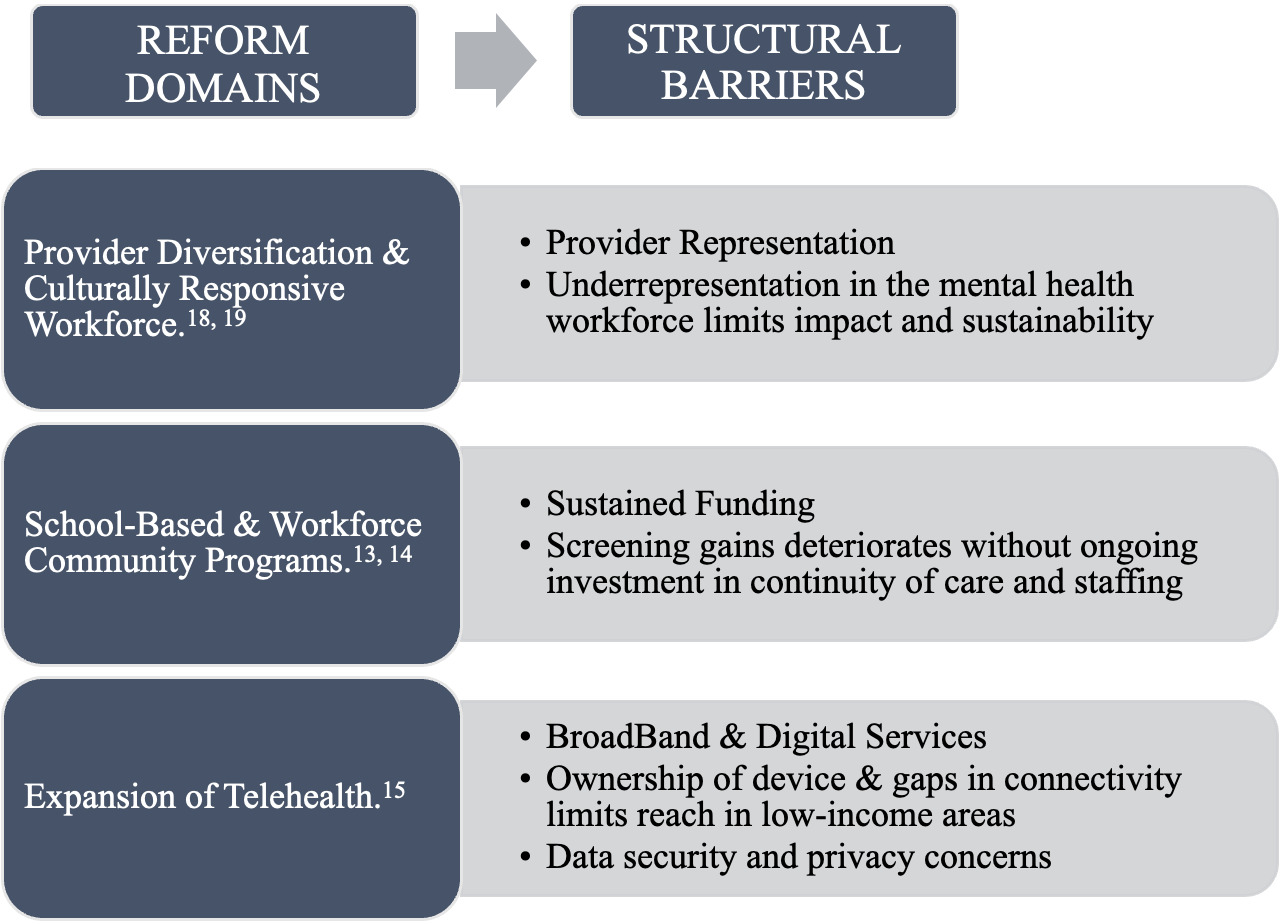
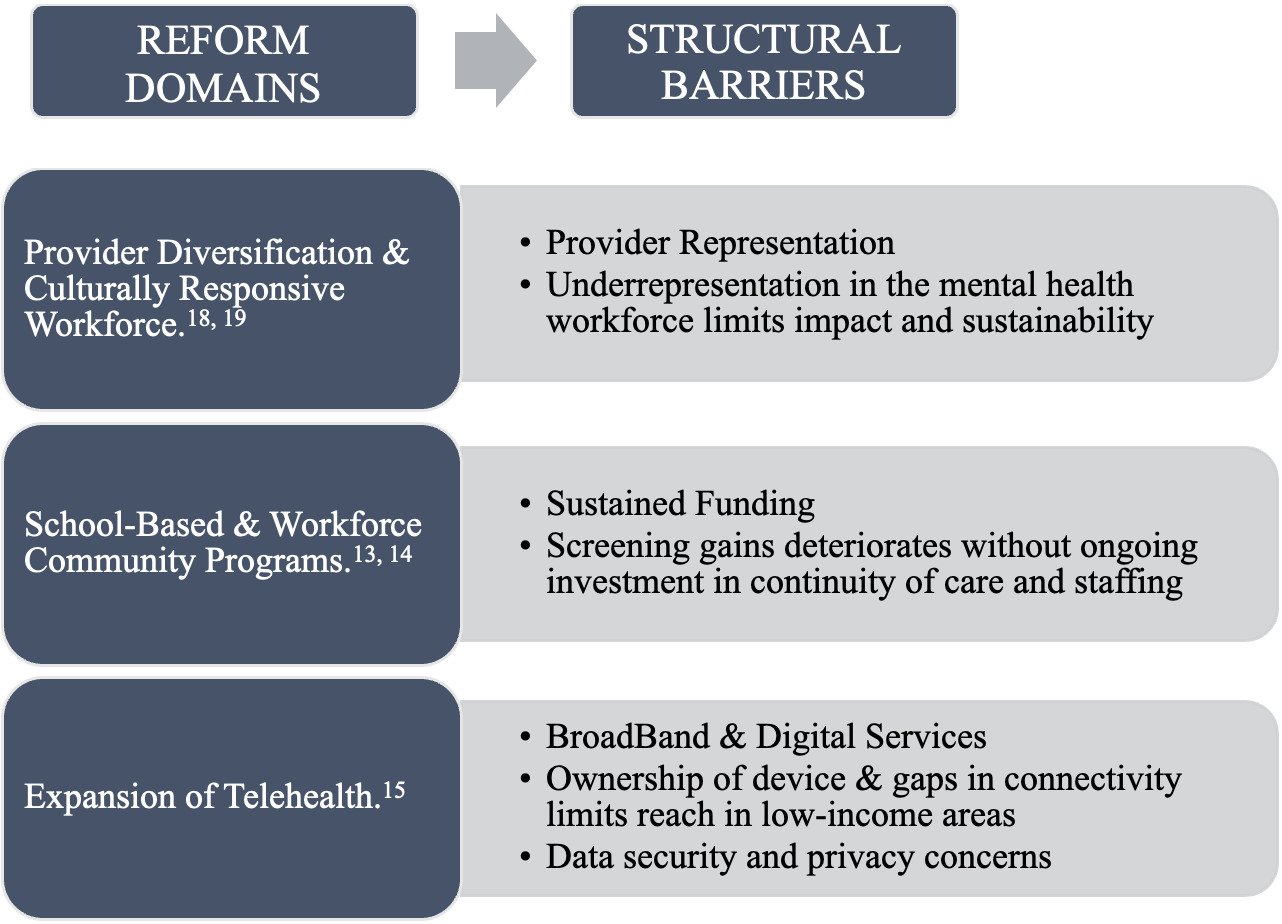
Findings further suggested that provider diversification, school-based services and community programs, and expansion of telehealth each include benefits that demonstrate capacity to reduce access disparities, but that benefits remain uneven without strategic focus on structural barriers such as sustained funding, broadband access, and provider representation.13–15,17,18 Figure 1 summarizes these structural barriers and the reform domains with which each is associated. A 2025 equity-focused systematic review of the implementation of the 988 Suicide and Crisis Lifeline, the national three-digit crisis line launched in July 2022, similarly discovered limited awareness of the service amongst populations of color and insufficient linguistic and cultural competence in its rollout, indicating that enhancing crisis call services is not sufficient without targeted consideration of whom it currently fails to serve.23
Discussion
Mental health inequity persists as a critical public health challenge of the century. Mental healthcare disparities indicate more extensive structural vulnerabilities that unevenly affect marginalized populations and communities. Healthcare systems of recent times consistently prioritize stabilization of crises while neglecting infrastructure that is preventative and creates long-term wellness.
This paper emphasizes the essence of building a culturally responsive workforce, community-centered care models, and prevention-oriented public health interventions in advancing mental health equity. These strategies jointly highlight representation, reforms in systems, and accessibility rather than personal responsibility alone.
Notably, interdisciplinary collaboration amongst educators, policymakers, public health practitioners, healthcare professionals, and community leaders is required for meaningful progress. Sustainable reforms must include strategic investments that enhance mental healthcare infrastructure while addressing fundamental social determinants of health. Community-based models have consistently indicated that integrative approaches can improve engagement and access among underrepresented and underserved communities. For instance, Certified Community Behavioral Health Clinics (CCBHCs) have extended availability of collaborative care models, care management, and crisis response for persons with critical behavioral illnesses and substance use.10 Likewise, the federal 988 Suicide and Crisis Lifeline has improved accessibility to crisis support, yet many populations and local communities do not have enough stabilization services.10 New York, Oregon, and other jurisdictions have invested in Mobile Crisis Teams, which provide a model that holds promise for reducing the criminalization of mental illness by dispatching mental or behavioral health professionals as opposed to law enforcement officers.9,25 The United Kingdom’s Improving Access to Psychological Therapies (IAPT) initiative and Australia’s headspace program have also established that community-based and national approaches to mental healthcare can significantly reduce treatment gaps.26,27
Nonetheless, significant gaps remain despite these advances. Many individuals who contact the 988 Lifeline do not receive continuity of care after initial crisis contact due to underfunding. CCBHCs have also not been established in all states. Furthermore, workforce shortages continue to persist, and training requirements for trauma-informed care and structural competency also remain inconsistent across state professional licensing bodies.
It is therefore imperative to address these gaps across multiple levels. Sustained funding mechanisms should be put in place for the 988 system that cover the stabilization of community services. Policymakers at the federal level should also extend the CCBHC certification across the nation. The Mobile Crisis Team programs should be funded at the state and local levels, support the community health worker stream from underrepresented and underserved communities, and extend the investment in school-based mental health services. Community organizations and public health leaders also have a role to play in documenting accessibility and outcome disparities, evaluating the effectiveness of programs, and ensuring that the program design and policy reforms are informed by individuals with lived mental health experiences.
Achieving mental health justice takes more than helping individuals, communities, and national systems navigate crisis. It demands building systems where individuals can belong, heal, and thrive in environments that are equitable and support their psychological well-being.
Limitations
As a narrative review rather than a systematic review, this commentary has a number of limitations. The literature was not exhaustive, and the source selection was not independently verified by a second reviewer, although it was guided by clearly stated inclusion and exclusion criteria. This introduces the possibility of selection bias towards literature that supports the paper’s thematic framing. The evidence was also skewed toward sources based in the United States. At the same time, IAPT data, headspace, and the WHO were included to provide international context; evidence from low- and middle-income countries was not addressed. Additionally, findings for some interventions considered, such as workplace screening programs and co-responder crisis models, are preliminary or mixed, and this paper’s perspective should not be considered as validating the effectiveness or impact of a particular reform. Lastly, given that this is a policy-oriented and conceptual commentary rather than an empirical study, it does not report on emerging primary data and cannot determine causal relationships between the proposed reforms and mental health outcomes.
Implications for Practice, Policy, and Future Research.
For practice, health systems and community organizations should integrate behavioral health screening and referral pathways into schools, workplaces, and primary care settings, paired with sustained follow-up care rather than screening alone.
For policy, federal and state policymakers should extend CCBHC certification nationwide, secure sustained funding for 988 stabilization services, fund Mobile Crisis Team programs at state and local levels, and adopt privacy and data-security standards specific to behavioral telehealth platforms. Addressing the behavioral health workforce shortage globally and in the U.S. also requires expanding the scope of practice for advanced practice nurses, particularly Psychiatric/Mental Health Nurse Practitioners (PMHNPs), whose expanded deployment can extend specialty mental health care to underserved and rural communities.
Future research priority areas can include thorough comparative evaluation of co-responder versus non-police crisis models across diverse jurisdictions; longitudinal research on the cost-effectiveness of prevention-focused behavioral healthcare at the systems level; and expanded international and low- and middle-income countries-focused research on community-based mental health reform.
Conclusion
Mental health inequity stands out as a public health crisis influenced by economic, cultural, racial, and structural disparities. Communities that are marginalized and underserved continue to face significant vulnerabilities in accessing quality mental healthcare services, resulting in poor mental health outcomes that are preventable. Reframing behavioral healthcare as a necessary public infrastructure is required to address these inequities. Building a culturally responsive workforce, shifting from crisis response to prioritizing prevention, and diversifying community-based systems are essential steps toward achieving health justice. It is imperative for future public health interventions to prioritize policy reforms that are centered on equity and capable of establishing mental healthcare that is inclusive, accessible, sustainable, and preventative for all populations.
Positionality
I am a Black Ghanaian male, a public health professional, and a mental health counselor-in-training. My perspectives on health equity, mental health, and access to care have been influenced by my academic and professional experiences in Ghana and the United States. My work is informed by a commitment to addressing disparities among underserved populations and underrepresented communities. While these experiences may influence my interpretation of the topic, I have approached this work with critical reflection, transparency, and a commitment to evidence-based analysis. Throughout this paper, I maintained transparency by separating empirical findings from peer-reviewed literature and federal program data from my interpretive analysis, grounding each claim in a cited source and revisiting the evidence base to ensure my conclusions remained supported by the literature rather than by my prior assumptions.
Acknowledgments
N/A
Disclosure Statement
The author has no relevant financial disclosures or conflicts of interest.
About the Author
James Odum Arthur, MPH
James Arthur is a mental health counselor-in-training, public health professional, and researcher at East Tennessee State University. His work focuses on mental health equity, social justice, HIV prevention, sexual minority health, and community-based public health interventions. He holds a Master of Public Health from the Presbyterian University, Ghana, and a bachelor’s degree in Health Services Administration and Psychology from the University of Ghana. James has presented at national conferences on HIV and mental health, has been recognized as a BCPH Health Justice Scholar Competition Winner, and as a 40 Under 40 Public Health Catalyst Honoree.