Loading [Contrib]/a11y/accessibility-menu.js
1.
Grant CC. Comparison of eGFR Outcomes in Black Populations Using the 2009 CKD-EPI with Race Adjustment Equation and the 2021 CKD-EPI without Race Modifier Equation: A  Review. BCPHR. Published online March 31, 2026. doi:10.54111/001c.159899
Download all (3)
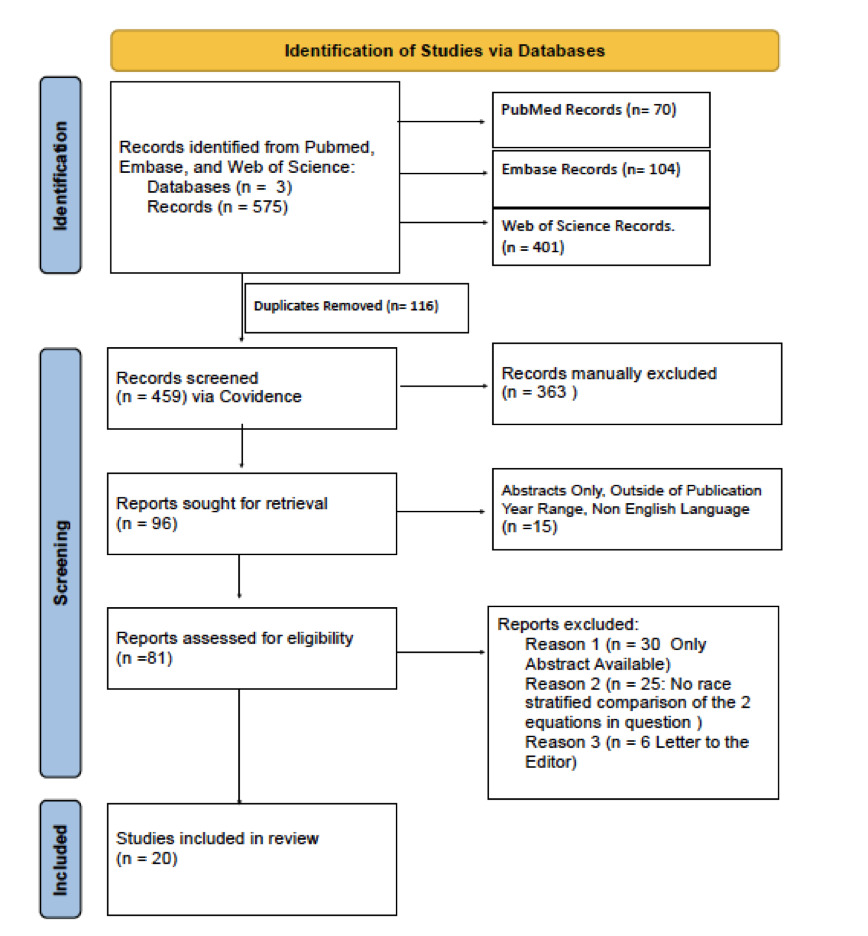
  • Figure 1. PRISMA Flow Diagram: Workflow for the identification of relevant studies to compare the CKD-EPI 2009 and 2021 equations in the Black population.
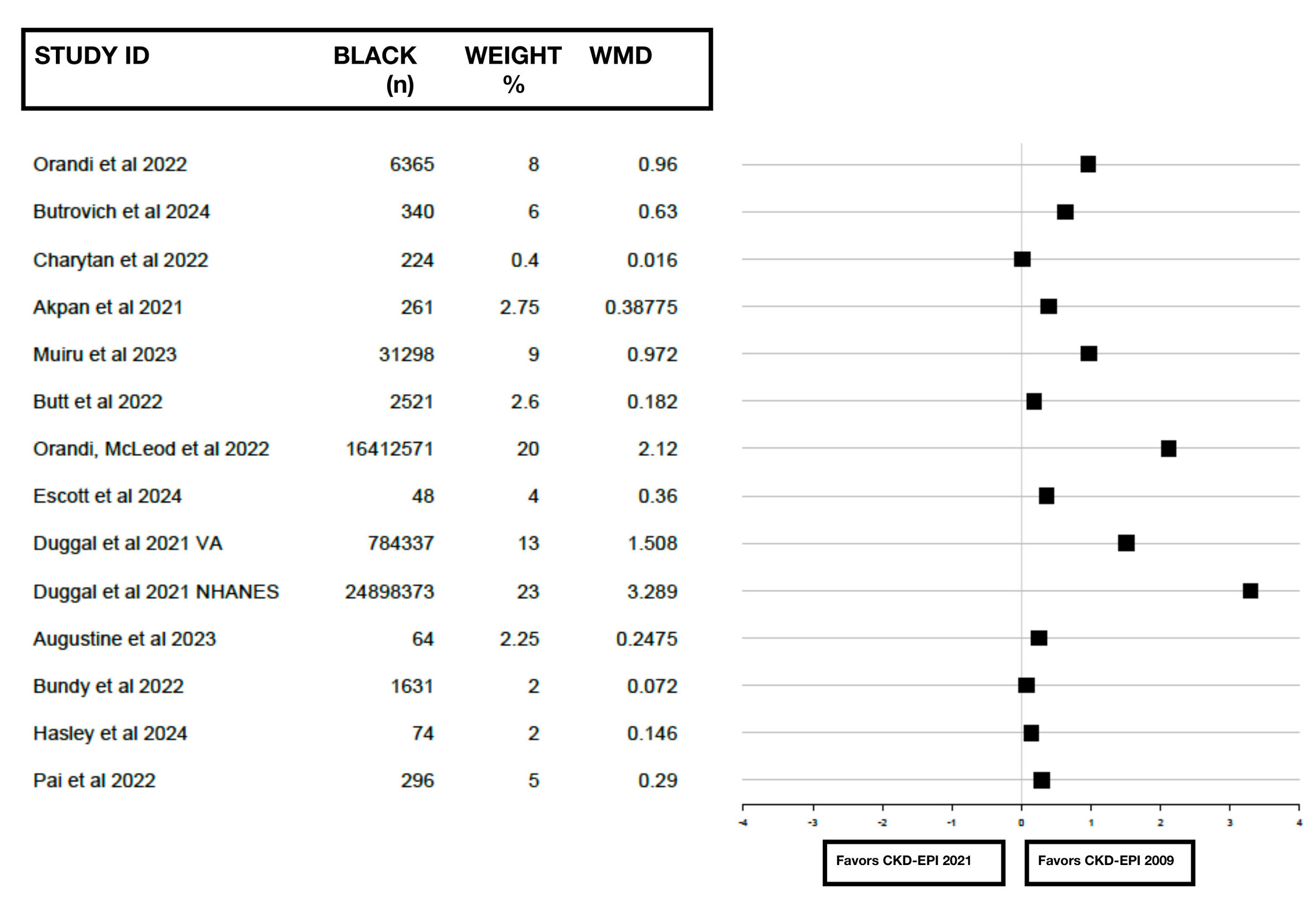
  • Figure 2. Forest plot depicting the weighted mean differences (WMD) between eGFR calculated by the 2009 CKD-EPI and 2021 CKD-EPI equations in the respective studies.
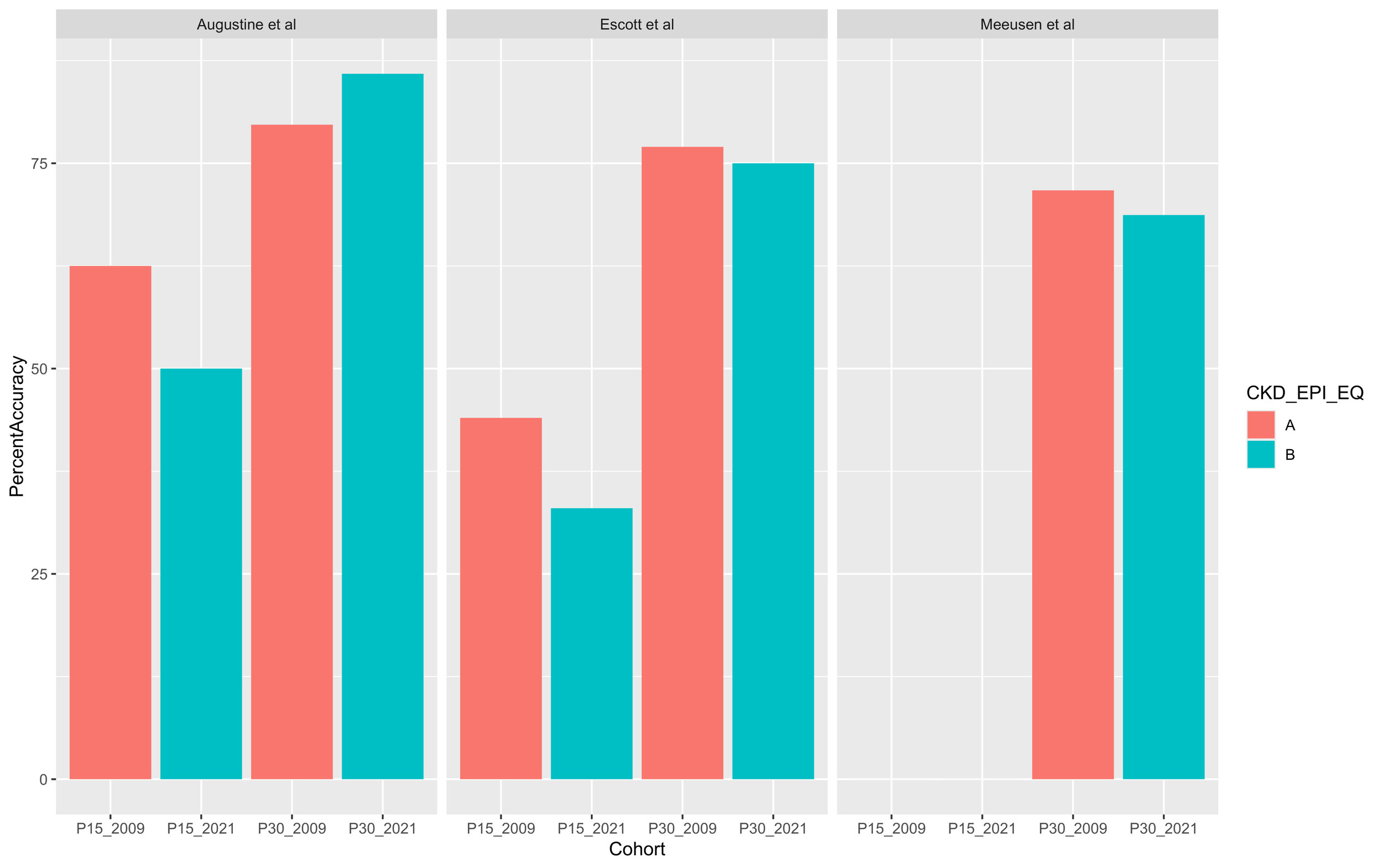
  • Figure 3. Bar graph depicting P15 (eGFR within 15% of measured GFR values) and P30 (eGFR within 30% of measured GFR values) accuracies of the CKD-EPI 2009 and 2021 equations across 3 cohorts. A or pink collation represents 2009 CKD-EPI equation. B or blue collation represents 2021 CKD-EPI equation.

Abstract

The National Kidney Foundation-American Society of Nephrology Task Force has recommended the 2021 CKD-EPI equation that omits the race correction factor following conversations concerning the social construction of race. Studies comparing the estimated GFR based on the 2009 and 2021 CKD-EPI equations against measured GFR have demonstrated a worsening of CKD classification in Black populations when using the 2021 equation. The objective of this review is to understand the extent of the difference in eGFR calculated by CKD-EPI equations with and without the Black race modifying coefficient by examining this outcome in literature studies. Embase, PubMed, and Web of Science databases were surveyed in August 2024 for literature published from 2021 onwards directly comparing the 2009 and 2021 CKD-EPI formulae in Black populations. 20 full text articles meeting the pre-established criteria are included in the review and are analyzed by outcomes in mean eGFR, CKD reclassification, percent accuracy, and drug eligibility. Statistical analysis is conducted with R 4.2.3 software. Mean eGFR in Black populations of the selected studies is 89.757 (18.65, SD) using the 2009 race inclusive equation compared to 80.357 (17.32) using the 2021 equation. The 2009 CKD-EPI equation demonstrates 11-12.5% greater P15 accuracy than the 2021 equation in two cohorts. Creatinine based eGFR equations omitting the correction factor in Black populations therefore lead to inaccurate renal function indices when compared to the gold standard measured GFR.

INTRODUCTION

As of 2023, the international burden of chronic kidney disease (CKD) has been estimated to be 788 million people aged 20 years and older, with CKD being the ninth leading cause of death globally, and the 12th leading cause of Disability Adjusted Life Years (DALYs).1 In the context of a global CKD prevalence of 14.2%, the prevalence of CKD in African Americans in the United States is 18.4% while that of Sub-Saharan Africans ranges from 2-41%.2 The clinical determination of chronic kidney disease is based upon two variables: glomerular filtration rate (GFR) that could be either measured or calculated and albuminuria which is a measurable parameter.3 CKD is characterized by a calculated GFR less than 60 mL/min/1.73 m2 over the course of 3 months or a urine albumin to creatinine ratio greater than 30mg/g. Given that acquiring the gold standard measurable parameters is both costly and time-consuming, calculated or estimated GFR (eGFR) that utilizes biomarkers such as creatinine and Cystatin C is the most commonly used method of kidney function analysis. Directly correlated to patient muscle mass, creatinine represents a less stringent biomarker of renal function as compared to its newly recognized Cystatin C counterpart. Yet, at least 50 different equations including the Cockcroft and Gault as well as the Modification of Diet in Renal Disease (MDRD) equations are based on the creatinine marker since initial presentation in literature in 1957.4

Developed in the United States in 2009, the Chronic Kidney Disease Epidemiology (CKD-EPI) equation includes age, sex, and race factors and is the former standard recommended by Kidney Disease: Improving Global Outcomes (KDIGO) international guidelines. The race factor is incorporated in this version of the equation as it accounts for the differentially higher creatinine levels demonstrated by African American individuals as compared to Caucasian counterparts in observational studies measuring GFR. Movements toward removal of the racial factor from the original CKD-EPI formula launched in 2019 with discussions of the social construction of race and ultimately culminated in the race-free CKD-EPI 2021 equation.5 Though race as a social construct has been weaponized to create subdivisions used to subject whole groups to grossly aversive discrimination, the race factor of the CKD-EPI equation accounts for biological differences in inherent glomerular filtration rates observed in population studies. Prior to the introduction of the race factor in 2009, decreased accuracy as compared to measured GFR was broadly noted particularly in Black Americans. Elimination of this race factor now introduces disparities in medication access as seen in an observational retrospective study looking at metformin access among patients with CKD.6 In this particular study, transition to the race blind CKD-EPI equation translates into disqualified eligibility for a low cost diabetes disease modifying medication. Since other disease modifying therapies for hypertension and heart failure such as RAAS modulators and SGLT2 drugs also have GFR limiting criteria, a move to a race naive CKD-EPI equation may also limit access to these life changing medications.

Nevertheless, since its entry into the literature, the National Kidney Foundation-American Society of Nephrology Task Force has recommended the 2021 CKD-EPI equation for implementation in clinical laboratories (Table 1).7 As of 2023, 65.8% of US laboratories reported adoption of the 2021 CKD-EPI equation.8 Barriers to adoption of this equation in Europe include reluctance to shift from the current European Kidney Function Consortium (EKFC) standard that itself does not include a racial factor and that has demonstrated consistent accuracy in European populations.9 In Sub-Saharan Africa, a population study in Malawi, Uganda, and South Africa demonstrated a 14 point lowering of median eGFR with the 2021 equation, and has therefore stalled overall implementation of the updated equation.10 In Asia, the reclassification of a greater proportion of its population to lower risk GFR categories begs further investigation before complete adoption of the 2021 CKD-EPI equation on a continental level.11 The Canadian Society of Nephrology, however, has commissioned a committee to mediate the adoption of the newer equation in agreement with the National Kidney Foundation-American Society of Nephrology Task Force.

Table 1.CKD-EPI Formulae
Equation CKD-EPI Equation Formula
2009 CKD-EPI eGFR = 141 * min(Scr/κ, 1)a * max(Scr/κ, 1)-1.209 * 0.9929 Age * 1.018 [if female] * 1.159 [If black],
2021 CKD-EPI eGFR = 142 * min(Scr/κ, 1)a * max(Scr/κ, 1)-1.200 * 0.9938 Age * 1.012 [if female]
2012 CKD-EPI Cystatin C eGFR= 133 * min (Scys/0.8,1)-0.499 * max (Scys/0.8,1)-1.328 * 0.996Age * 0.932 [if female]

GFR output unit is mL/min/1.73m2, Scr is serum creatinine in mg/dL, K correction factor is 0.7 for females and 0.9 for males, and a is -0.241 for females and -0.302 for males.7 Scys is standardized serum cystatin C in mg/dL.12

Despite median eGFR of up to 4mL/min/1.73m2 lower and higher values compared to gold standard measured GFR (mGFR) for Black and non-Black individuals respectively, the 2021 race free equation is currently the silver standard for diagnosing kidney disease across the KDIGO CKD classification brackets.13 With omission of race in this later equation, Black individuals are projected to have 2.0% higher prevalence of CKD while non-Black persons have 1.5% lower prevalence compared to previous race adjusted formulae.13 This reclassification of Black individuals into higher stages of CKD has negative implications leading to contraindication and dose restriction for certain prescription drugs, unwarranted referral for nephrology care and kidney transplantation, and decreased eligibility for kidney donation and clinical trial participation. Though the 2021 CKD-EPI equation’s tendency to underestimate eGFR in Black populations and to overestimate eGFR in non-Black counterparts has been noted, the equation continues to dictate treatment protocols and referrals for kidney replacement therapies on an individual basis. With more Black individuals being classified into higher risk CKD stages within the context of the 2021 CKD-EPI equation, more of this population may be pre-emptively condemned to dialysis, a thrice weekly therapy that comes with high economic and quality of life costs.

A narrative review targeting health care providers is therefore undertaken to analyze the extent of the effect of the 2009 and 2021 iterations of the CKD-EPI equations on measures of renal function in Black populations across the globe. The objective of this review is to assess the eGFR outputs for the two equations across various cohorts in an effort to quantify the effect of the elimination of the race factor on CKD classification, eGFR accuracy, and drug eligibility. This review aims to shed light on the downstream effects of an already implemented health care policy change in eGFR calculation. It targets providers who must use these calculations to refer patients to nephrology specialists who then must use eGFR along with other measures to determine dialysis necessity.

METHODS

The following narrative review is conducted in accordance with an ‘a priori’ protocol published in Open Science Framework.14

Search strategy

An initial limited search of PubMed is undertaken to identify articles on the topic. The text words contained in the titles and abstracts of relevant articles are then used to develop a full search strategy in conjunction with a librarian. The reference lists of all included sources of evidence are screened for additional studies. The databases searched include Embase, Web of Science, and PubMed. Studies published in English only and published between 2021 and 2024 are included in the final review.

Inclusion criteria

The review seeks to include studies from across the globe that look at both male and female adults aged 18 and above. Analytical as well as descriptive observational studies including prospective and retrospective cohort studies, case-control studies and analytical cross-sectional studies are considered for inclusion. Research article types such as conference abstracts and research letters are excluded during the screening process. Studies where only non-Black populations are analyzed are excluded from the review. Only studies that directly compare the CKD-EPI 2021 equation with the CKD-EPI 2009 race adjusted equation head to head are included. Only studies with outcomes in median GFR, mean GFR, percent accuracy, CKD reclassification, medication administration, medication dosing, and treatment access are included in the narrative review.

Source of evidence selection

Following the search, all identified citations are collated and uploaded into Covidence software and duplicates are auto-removed. Titles and abstracts are then screened for alignment with the inclusion criteria. Potentially relevant sources are retrieved in full and their citation details recorded. Reasons for exclusion of sources of evidence at full text that do not meet the inclusion criteria are also recorded and reported in the narrative review. The results of the search and the study inclusion process are reported in full and are presented in a PRISMA flow diagram.15

Data extraction

Data are extracted from papers included in the review using a word-based data extraction tool developed by the reviewer. The data extracted include specific details about the participants, concept, context, study methods, and key findings relevant to the review question such as citation details, country of study, total participants, and population kidney disease status. One of the primary outcomes includes accuracy or the proportion of patients with eGFR values within a given threshold of measured GFR, whether that be within 15% of mGFR (P15) or 30% of mGFR (P30). Quality assessment of the included studies is conducted using the Critical Appraisal Skills Program Checklist for Descriptive/Cross-Sectional Studies.16 Graphical representation of extracted data through forest plot and bar graph is conducted via R statistical programing software version 4.2.3.

RESULTS

Identification of publications for Data Extraction

Following use of defined MeSH terms, 575 publications are identified via the 3 disclosed databases. This is then narrowed to 459 publications upon computerized removal of duplicate records (Figure 1). Using Covidence to then screen these records allows for the exclusion of 363 records based on unfitting populations of study, for example, those looking at ‘eGFR’ as it pertains to ‘epidermal growth factor receptors’. Comparisons between GFR equations not of interest are also grounds for exclusion during this screening phase. Of the remaining 96 records, 15 are excluded based on pre-established inclusion criteria, leaving 81 reports assessed for review inclusion. After eliminating publications that do not assess race stratified comparisons of the 2009 and 2021 CKD-EPI formulae via median GFR, mean GFR, CKD reclassification, and drug eligibility, a total of 20 full text articles are included in the review.12,17–35

Figure 1
Figure 1.PRISMA Flow Diagram: Workflow for the identification of relevant studies to compare the CKD-EPI 2009 and 2021 equations in the Black population.

Outcomes measured to compare CKD-EPI equation performance

The 20 articles included in the review all report on the percentage of the study populations represented by Black individuals, with people identifying as Black representing from 2.5% to 100% (n = 45- 24,898,373) of populations under study (Table 2). The majority of these publications capture CKD-EPI performance through mean GFR, with 14 out of 20 (70%) studies measuring this outcome as shown in Table 3. 10 out of 20 (50%) articles measure CKD reclassification as the outcome variable, all concluding that the 2021 CKD-EPI equation comparatively worsens CKD stage in Black individuals (Table 2). 4 of the 20 (20%) studies evaluate the effect of the differential eGFR calculations on drug eligibility, concluding that the race naive 2021 equation disqualifies from 1.0% to 25% more Black individuals from drug consideration criteria compared to the 2009 race considerate equation (Appendix II). 3 (15%) of the articles compare the two equations to measured GFR and report outcomes within 15% or 30% from these measured values bi-directionally. 4 studies (20%) report median GFR, demonstrating 14 point greater GFR for the 2009 CKD-EPI equation in a cohort in Kenya and 6-7 point greater GFR in 2 US cohorts undergoing nephrectomy (Appendix II).

Table 2.Comparison of 2021 CKD-EPI eGFR to 2009 CKD-EPI and/or mGFR
Author Year Population Assessed N % Black mGFR Outcome Evaluated Brief Conclusion
2021 and 2009 equation vs mGFR
Escott et al.17 2024 Brazilians 354 13.50% Yes P30 and P15 Accuracy Compared to mGFR 2009 equation had greater accuracy
Meeusen et al.18 2022 Mayo Clinic 33889 2.50% Yes P30 Accuracy Compared to mGFR 2009 equation had greater crude accuracy
Augustine et al.19 2023 Cleveland Clinic 64 100% Yes P30 and P15 Accuracy Compared to mGFR 2009 equation had greater P15 accuracy
CKD staging reclassification
Orandi et al.20 2022 Renal transplant donors 63246 11.20% No % CKD reclassification 2021 CKD-EPI eGFR worsens CKD stage in Black individuals
Alsaeed et al.21 2024 Multi-center study in USA universities 4335 21% No % CKD reclassification with eGFR < 60 2021 CKD-EPI eGFR classifies more black individuals with CKD eGFR < 60.
Muiru et al.22 2023 North American AIDS Cohort Collaboration 69125 45% No % CKD reclassification 2021 CKD-EPI eGFR worsens CKD stage in Black individuals
Butt et al.23 2022 HFrEF Clinical trials 43138 5.80% No % CKD reclassification 2021 CKD-EPI eGFR worsens CKD stage in Black individuals
Gutierrez et al.24 2022 NHANES, Atherosclerosis cohort studies 62011 33.50% No % CKD reclassification with eGFR < 60 2021 CKD-EPI eGFR classifies more black individuals with CKD eGFR < 60.
Diao et al.25 2023 NHANES 44360 21.50% No % CKD reclassification with eGFR < 60 2021 CKD-EPI eGFR classifies more black individuals with CKD eGFR < 60.
Duggal et al.26 2021 NHANES, Veteran Affairs Health Care System 232,091,032 11.00% No % CKD reclassification with eGFR < 60 2021 CKD-EPI eGFR classifies more black individuals with CKD eGFR < 60 across two patient cohorts.
Meeusen et al.18 2022 Mayo Clinic 33889 2.50% Yes % CKD reclassification 2021 CKD-EPI eGFR worsens CKD stage in Black individuals
Bundy et al.27 2022 Multiple (7) US clinical chronic renal insufficiency centers 3873 42.10% No % CKD reclassification 2021 CKD-EPI eGFR worsens CKD stage in Black individuals
Halsey et al.28 2024 Nephrectomy Cohort University Hospital NJ 1137 6.50% No % CKD reclassification 2021 CKD-EPI eGFR worsens CKD stage in Black individuals
Drug Ineligibility
Butrovich et al.29 2024 National Cancer Institute 3931 8.60% No % Drug Ineligibility 2021 CKD-EPI equation disqualified higher proportion of Black individuals from drug consideration criteria
Butt et al.23 2022 HFrEF Clinical trials 43138 5.80% No % Drug Ineligibility 2021 CKD-EPI equation disqualified higher proportion of Black individuals from drug consideration criteria
Orandi et al.30 2022 NHANES 126,067,322 13% No % Drug Ineligibility 2021 CKD-EPI equation disqualified higher proportion of Black individuals from drug consideration criteria
Alsaeed et al.21 2024 Multi-center study in USA universities 4335 21% No Reduced Drug Effectiveness 2021 CKD-EPI equation would lead to more cases of PCI drug not being recommended due to projected reduced effectiveness
Median eGFR
Antony et al.31 2022 National Cancer Institute 336 8.1% No Median eGFR Higher median eGFR seen with 2009 CKD-EPI equation
Schmeusser et al.32 2023 Tertiary Referral Center 1443 22.9% No Median eGFR Higher median eGFR seen with 2009 CKD-EPI equation
Omuse et al.12 2023 Cohort in Kenya 533 100% No Median eGFR Higher median eGFR seen with 2009 CKD-EPI equation
Mean eGFR
Charytan et al.33 2022 CREDENCE Trial 4401 5% No Mean eGFR Higher mean eGFR seen with 2009 CKD-EPI equation.
Akpan et al.34 2021 Cohort in Nigeria 261 100% No Mean eGFR Higher mean eGFR seen with 2009 CKD-EPI equation.
Pai et al.35 2022 University of Michigan Database 2968 10% No Mean eGFR Higher mean eGFR seen with 2009 CKD-EPI equation.
Table 3.Mean eGFR for 2009 and 2021 CKD-EPI Equations
Study ID 2009 CKD-EPI Mean eGFR (SD) 2021 CKD-EPI Mean eGFR (SD)
Orandi et al 2022 109.7 (19.94) 97.7 (17.34)
Butrovich et al 2024 104.7 (14.94) 94.2 (13.84)
Charytan et al 2022 55 (-34.76) 51 (-29.357)
Akpan et al 2021 104.2 (14.44) 90.1 (9.74)
Muiru et al 2023 103.4 (13.64) 92.6 (12.24)
Butt et al 2022 75 (-14.76) 68 (-12.36)
Orandi, McLeod et al 2022 101.5 (11.74) 90.9 (10.54)
Escott et al 2024 90 (0.24) 81 (0.64)
Duggal et al 2021 VA 87.3 (-2.46) 75.7 (-4.66)
Duggal et al 2021 NHANES 104.5 (14.74) 90.2 (9.84)
Augustine et al 2023 106 (16.24) 95 (14.64)
Bundy et al 2022 43.6 (-37) 40 (-40.36)
Hasley et al 2024 80.6 (-9.16) 73.3 (-7.06)
Pai et al 2022 91.1 (1.34) 85.3 (4.94)
OVERALL 89.757 (18.65) 80.357 (17.32)

Comparison of eGFR calculations in Black populations

Mean eGFR reported across the 14 studies measuring this outcome in populations ranging from 48 to 24,898,373 (n) Black individuals is 89.757 (18.65, SD standard deviation) using the 2009 race inclusive equation compared to 80.357 (17.32) using the 2021 equation (Table 3). The difference between the mean eGFR outcomes favors the CKD-EPI 2009 equation in all 14 cases, with mean difference ranging from +4 to +14.3 points. Greater eGFR values are consistently seen with the 2009 equation even when weights are assigned to each study based on both the number of Black persons (n) represented by the study as well as the health status of the cohort individuals (Figure 2). When comparing the 15 percent accuracy outcome, the 2009 CKD-EPI equation demonstrates 11-12.5% greater accuracy than the 2021 equation in two cohorts (Figure 3). The CKD-EPI 2009 equation again demonstrates greater accuracy than the 2021 equation with margins between 2-3% in 2 of the 3 cohorts analyzing 30 percent accuracy, alluding to the concept that the Black race modifier of the 2009 equation lends to estimated filtration rates closer to the gold standard measured GFR.

Figure 2
Figure 2.Forest plot depicting the weighted mean differences (WMD) between eGFR calculated by the 2009 CKD-EPI and 2021 CKD-EPI equations in the respective studies.

0 represents no difference between the mean eGFR amongst the two equations. Positive (>0) WMD indicates that mean eGFR is greater when calculated with the 2009 CKD-EPI equation as opposed to the 2021 CKD-EPI.

Figure 3
Figure 3.Bar graph depicting P15 (eGFR within 15% of measured GFR values) and P30 (eGFR within 30% of measured GFR values) accuracies of the CKD-EPI 2009 and 2021 equations across 3 cohorts. A or pink collation represents 2009 CKD-EPI equation. B or blue collation represents 2021 CKD-EPI equation.

DISCUSSION

Obesity, diabetes, and hypertension are the leading risk factors for chronic kidney disease development. African Americans have higher prevalence of these three comorbidities compared to their White counterparts with 76.4% compared to 68.5% prevalence of obesity, 18% compared to 9.6% prevalence of diabetes, and 43.3% compared to 29.1% prevalence of hypertension respectively.36 Contributing to the increased burden of CKD in the Black population is poverty with 20% of African Americans in the United States falling below the federal poverty line compared to 9% of Caucasians in 2018. Lacking health literacy and insurance further yields to the nearly 3 fold increased incidence of end stage renal disease (ESRD) in the Black minority population compared to White counterparts and to the 1.5 fold increased incidence compared to the general population. Given the immense healthcare usage costs, time expense, and physical demands that CKD and ESRD impose on the individual, it is crucial that diagnosis is accurate, timely, and not premature.

Before implementation of the race naive 2021 eGFR creatinine-based equation, bias in eGFR calculations in Black and non-Black individuals was noted, with increased values and therefore healthier CKD classifications observed in non-Black populations of appropriately matched creatinine levels.13 It is unclear, however, whether this bias towards lower eGFR values in Black persons represent true worsened renal function masked by the 2009 equation or exaggerated CKD staging that then leaves this population with unwarranted replacement therapy referrals and limited access to renally dosed medications. Muiru et al. present findings comparing the risk of CKD progression for black individuals with the 2009 and 2021 eGFR equations, demonstrating 3 fold risk of progressing from CKD 3 to CKD stage 4 or 5 (HR 3.06, 2.60 -3.62 CI) compared to non-Black counterparts using the 2009 equation as opposed to about 2 fold risk (HR 1.71, 1.45- 2.02 CI) of the same disease progression with the 2021 race naive calculations.14 While the lower risk of progression between these particular CKD stages observed with the 2021 formula implies that accelerated rates of kidney disease progression at later CKD stages may have been masked by the 2009 black race modifier, Muiru et al. looks at HIV/AIDS cohorts as opposed to the healthy subjects that formed the basis of the original 2009 CKD-EPI equation.

A case report of a 72 year old African American woman further discusses the differential kidney disease progression rates in CKD stages 4-5 represented by the two equations.37 This case describes a woman who qualifies for renal transplant referral based on the race unadjusted equation who ultimately waits 1 year to be added to the transplant list because the race modified equation categorizes her with an eGFR higher than the threshold for transplant referral. If the equation without race modifier had been applied to her case, she would have been referred for renal transplant 12 months earlier. An alternative interpretation of this particular case report is to view the patient’s lacking need of dialysis for 12 months as proof of concept that the 2009 CKD-EPI accurately depicts disease extent and reflects the urgent rather than emergent need for renal replacement therapy.

Earlier iterations of the equations estimating kidney function were derived exclusively from studies involving Caucasians and only considered this racial group. It turns out that these equations had decreased accuracy in Black Americans leading to the introduction of race based modifiers statistically derived from diverse populations. Inclusion of the 1.159 Black race correction factor in the original CKD-EPI equation of 2009 increases eGFR by 15.9% to account for the higher serum creatinine and differential tubular secretion seen in this population at counterpart-matched mGFR, age, and sex.20,32 The mean serum creatinine levels observed in non-Hispanic Black men based on the Third National Health and Nutrition Examination Survey of 1988-1994 was 1.25 mg/dL compared to a mean of 1.16 mg/dL observed in Caucasian males.38 Estimated GFR values based on observed elevated levels of serum creatinine markers were calibrated against measured clearances such that mean creatinine values of the respective racial groups were made equivalent and the biological differences in creatinine filtration were accounted for in the 2009 CKD-EPI formula.7,39 The 2009 eGFR formula therefore accounts for the phenotypic differences observed between Black individuals and their non-Black counterparts in NHANES III-IV through the 1.159 Black race correction coefficient.

The K correction factors for sex, 0.70 mg/dL for females and 0.90 mg/dL for males, present in both the race conscious and race naive creatinine based equations are in fact the mean serum creatinine levels specifically observed in healthy Caucasian populations in NHANES IV.7,40,41 The 2021 race naive creatinine based eGFR formula, therefore, inadvertently carries forward remnants of racial bias by including the K correction factor that is itself imbedded in observed racial differences in serum creatinine levels. Though the implementation of the 2021 race naive eGFR equation is aimed at eliminating race as a construct from an equation estimating a biological phenomenon, its incorporation of the K factor defeats the purpose of this public health policy change. By reverting to a version of the equation that only studied kidney function in White populations, the policy change ignores the inherent differences across ethnicities and unintentionally reinforces a racial bias of its own. It is in this clinical context that race is indeed a phenotypic factor and not a social construct as referred to in recent global discussions.

The idea of race as a social construct in reference to the eGFR formulae likely did not surface until a more precise serum marker of renal clearance, Cystatin C, entered the arena and demonstrated reduced racial bias.42 The 2012 CKD-EPI Cystatin C equation is represented in Table 1. Bias, defined as mGFR – eGFR, is closest to zero with the 2012 CKD-EPI cystatin C equation in Black and non-black individuals as compared to not only the 2009 and 2021 creatinine based eGFR equations but also the 2021 CKD-EPI creatinine/cystatin C combined formula with K correction factor. Additionally, within a meta-analysis encompassing 44,721 participants, cystatin-C based equations not incorporating the K correction factor demonstrated no significant difference in P30 accuracy between Black and non-black individuals with P30 of 85.3% and 85.7% in Black and non-Black persons respectively.42 This means that with cystatin C based equations even without a race factor, both Black and non-Black persons are designated to CKD classifications that accurately define their long term kidney health status and that grant them equitable access to renally dosed medications. As opposed to race naive creatinine based eGFR equations, race naive cystatin C based equations such as the 2012 CKD-EPI cystatin C allows for patients to access medication and treatment modalities including dialysis when medically indicated. Unlike the creatinine/cystatin C combined formula, Cystatin C based calculations without the K correction factor have the potential to remove structural barriers to renal replacement therapies among not only Black individuals but also other ethnicities who require this step up in treatment.

CONCLUSION

The presented narrative review yielding 20 studies published following National Kidney Foundation Task Force guideline recommendations in 2021 provides further evidence towards the increased eGFR and percent accuracy demonstrated by the 2009 race inclusive creatinine-based equation in Black individuals. Findings allude to the idea that renal function estimated based on creatinine markers should include the Black race modifying coefficient considering the physiological and not the social nature of increased serum creatinine levels measured in this particular population. While the use of the 2021 race unadjusted equation has a goal of eliminating racial bias from kidney function calculations, inclusion of the K factor perpetuates observations based solely on a Caucasian population. Use of race adjusted creatinine based eGFR or Cystatin C based eGFR calculations therefore leads to less biased representations of kidney function in Black individuals, which leads to less misdiagnosis of CKD, less preclusion from therapeutic considerations, and less premature referral for renal replacement dialysis. Perhaps the race naive 2021 CKD-EPI equation would truly become race naive and would furthermore depict less underestimation of eGFR in Black populations if it were to disregard the racially biased K correction factor. If not for the cost of Cystatin C assessments, race naive Cystatin C eGFR calculations would offer the most accurate and socially conscious equation to be implemented into national and global policy.

LIMITATIONS

Limitations of this narrative review include the lack of eGFR stratification by age related comorbidities such as diabetes, hypertension, and heart disease as well as the absence of age adjusted definitions of CKD. This review is also limited by the use of creatinine-based GFR formulae instead of Cystatin C based equations, which yield less biased estimations of kidney function. This review does not assess for subgroup ethnic differences within the global Black population and considers these persons of the African diaspora as a single homogenous group. Furthermore, this review does not pursue sub-group analysis by patient setting. As this is a narrative review, this study does not assess publication bias via funnel plot or Egger’s regression test.


FUNDING

No funding sources were allocated for this narrative review.

CONFLICTS OF INTEREST

There is no reportable conflict of interest for this narrative review.

ACKNOWLEDGMENTS

I would like to express sincere gratitude to librarian Janice Lester at North Shore University Hospital for her work towards refining this study’s database search strategy.

Accepted: March 31, 2026 EDT

References

1.
Mark P, Stafford L, Grams M, et al. Global, regional, and national burden of chronic kidney disease in adults, 1990–2023, and its attributable risk factors: a systematic analysis for the Global Burden of Disease Study 2023. The Lancet. 2025;406:2461-2482. doi:10.1016/​S0140-6736(25)01853-7
Google Scholar
2.
U.S. Department of Health and Human Services. National Health Interview Survey, Healthy People 2030: Reduce the proportion of adults with chronic kidney disease. U.S. Centers for Disease Control and Prevention, National Center for Health Statistics. 2025. Accessed March 21, 2026. https:/​/​minorityhealth.hhs.gov/​kidney-disease-and-blackafrican-americans
3.
Levin A, Ahmed SB, Carrero JJ, et al. Executive summary of the KDIGO 2024 clinical practice guideline for the evaluation and management of chronic kidney disease: known knowns and known unknowns. Kidney International. 2024;105(4):684-701. doi:10.1016/​j.kint.2023.10.016
Google Scholar
4.
Delanaye P, Cavalier E, Pottel H, Stehle T. New and old GFR equations: a European perspective. Clinical Kidney Journal. 2023;16(9):1375-1383. doi:10.1093/​ckj/​sfad039
Google Scholar
5.
Inker LA, Eneanya ND, Coresh J, et al. New creatinine-and cystatin C-based equations to estimate GFR without race. N Eng J Med. 2021;385(19):1737-1749. doi:10.1056/​NEJMoa2102953
Google Scholar
6.
Shin JI, Sang Y, Chang AR, et al. The FDA metformin label change and racial and sex disparities in metformin prescription among patients with CKD. J Am Soc Nephrol. 2020;31:1847-1858. doi:10.1681/​ASN.2019101119
Google Scholar
7.
Levey AS, Stevens LA, Schmid CH, et al. A new equation to estimate glomerular filtration rate. Ann Intern Med. 2009;150(9):604-612. doi:10.7326/​0003-4819-150-9-200905050-00006
Google Scholar
8.
Genzen JR, Souers RJ, Pearson NJ, et al. An Update on Reported Adoption of 2021 CKD-EPI Estimated Glomerular Filtration Rate Equations. Clinical Chemistry. 2023;69(10):1197-1199. doi:10.1093/​clinchem/​hvad116
Google Scholar
9.
Roy R, Raman M, Dark PM, Kalra PA, Green D. Adoption of CKD-EPI (2021) for Glomerular Filtration Rate Estimation: Implications for UK Practice. Nephron. 2025;149(3):133-148. doi:10.1159/​000541689
Google Scholar
10.
Tarzi R, McKenzie J, Reid M, Richards A, Nwokolo N, Young B. Pharmaceutical practice considerations regarding adoption of the race-free chronic kidney disease epidemiology collaboration (CKD-EPI) 2021 equations. American Journal of Kidney Diseases. 2025;86:843-853. doi:10.1053/​j.ajkd.2025.06.022
Google Scholar
11.
Kim H. The new race-free equations for estimating glomerular filtration rate: should they be adopted for Asians? Kidney Res Clin Pract. 2023;42(6):670-671. doi:10.23876/​j.krcp.23.111. PMID:37644770
Google ScholarPubMed CentralPubMed
12.
Omuse G, Maina D, Sokwala A. The new creatinine-based chronic kidney disease epidemiology collaboration (CKD-EPI) 2021 equation: potential impact on screening for chronic kidney disease in an asymptomatic Black African population. JALM. 2024;9(3):502-511. doi:10.1093/​jalm/​jfae002
Google Scholar
13.
Delgado C, Baweja M, Crews DC, et al. A unifying approach for GFR estimation: recommendations of the NKF-ASN Task Force on Reassessing the inclusion of race in diagnosing kidney disease. J Am Soc Nephrol. 2021;32(6):1305-1317. doi:10.1681/​ASN.2021010039
Google Scholar
14.
Grant CC. The effect of CKD-EPI 2009 and CKD-EPI 2021 eGFR equations on CKD classification in the Black population. Open Science Framework. 2024. Accessed September 1, 2024. https:/​/​osf.io/​mcdxq
15.
Page MJ. PRISMA 2020 flow diagram for new systematic reviews which included searches of databases and registers only. BMJ. 2021;372(71). doi:10.1136/​bmj.n71
Google Scholar
16.
Critical Appraisal Skills Programme. CASP (Cross Sectional Checklist). 2024. Accessed March 23, 2026. https:/​/​casp-uk.net/​casp-tools-checklists/​
17.
Escott GM, Zingano CP, Ferlin E, et al. Is race adjustment necessary to estimate glomerular filtration rate in South Brazilians? Journal of Nephrology. 2024;37(9):2635-2645. doi:10.1007/​s40620-024-02001-x
Google Scholar
18.
Meeusen JW, Kasozi RN, Larson TS, Lieske JC. Clinical impact of the refit CKD-EPI 2021 creatinine-based eGFR equation. Clinical Chemistry. 2022;68(4):534-539. doi:10.1093/​clinchem/​hvab282
Google Scholar
19.
Augustine JJ, Liaqat A, Arrigain S, Schold JD, Poggio ED. Performance of estimated glomerular filtration rate equations in black living kidney donor candidates*. Clinical Transplantation. 2024;38(1):e15198. doi:10.1111/​ctr.15198
Google Scholar
20.
Orandi BJ, Kumar V, Reed RD, et al. Reclassification of CKD in living kidney donors with the refitted race-free eGFR formula. American Journal of Surgery. 2023;225(2):425-428. doi:10.1016/​j.amjsurg.2022.09.024
Google Scholar
21.
AlSaeed MJ, Thomas CD, Franchi F, et al. Evaluating the effect of estimating renal function with the CKD-EPI 2021 equation on the ABCD-GENE score for Clopidrogel response prediction. Clinical Pharmacology and Therapeutics. 2024;116(5):1227-1230. doi:10.1002/​cpt.3385
Google Scholar
22.
Muiru AN, Madden E, Scherzer R, et al. Effect of adopting the new race-free 2021 chronic kidney disease epidemiology collaboration estimated glomerular filtration eate creatinine equation on racial differences in kidney disease progression among people with human immunodeficiency virus: an observational study. Clinical Infectious Diseases. 2023;76(3):461-468. doi:10.1093/​cid/​ciac731
Google Scholar
23.
Butt JH, Adamson C, Docherty KF, et al. Eligibility for pharmacological therapies in heart failure with reduced ejection fraction: implications of the new chronic kidney disease epidemiology collaboration creatinine equation for estimating glomerular filtration rate. European Journal of Heart Failure. 2022;24(5):861-866. doi:10.1002/​ejhf.2460
Google Scholar
24.
Gutierrez OM, Sang Y, Grams M, et al. Association of estimated GFR calculated using race-free equations with kidney failure and mortality by black vs non-black race. JAMA. 2022;327(23):2306-2316. doi:10.1001/​jama.2022.8801
Google Scholar
25.
Diao JA, Wu GJ, Wang JK, et al. National projections for clinical implications of race-free creatinine-based GFR estimating equations. JASN. 2023;34(2):309-321. doi:10.1681/​ASN.2022070818
Google Scholar
26.
Duggal V, Thomas I, Montez-Rath ME, Chertow GM, Tamura MK. National estimates of CKD prevalence and potential impact of estimating glomerular filtration rate without race. JASN. 2021;32(6):1454-1463. doi:10.1681/​ASN.2020121780
Google Scholar
27.
Bundy JD, Mills KT, Anderson AH, Yang W, Chen J, He J. Prediction of end-stage kidney disease using estimated glomerular filtration rate with and without race: a prospective cohort study. Annals of Internal Medicine. 2022;175(3):305-313. doi:10.7326/​M21-2928
Google Scholar
28.
Hasley HL, Iarajuli T, Nguyen J, et al. Race-modified estimated glomerular filtration rate underestimates chronic kidney disease prevalence in black patients undergoing partial and radical nephrectomy: implications for surgical planning. Urology Annals. 2024;16(3):221-226. doi:10.4103/​ua.ua_7_24
Google Scholar
29.
Butrovich MA, Qin J, Xue X, Ivy SP, Nolin TD, Beumer JH. Impact of the 2021 CKD-EPI equation on anticancer pharmacotherapy in black and non-black cancer patients. Cancer Letters. 2024;586:e216679. doi:10.1016/​j.canlet.2024.216679
Google Scholar
30.
Orandi BJ, McLeod C, Reed RD, et al. Impact of refitted race-free eGFR formula on obesity pharmacotherapy options. Obesity (Silver Spring). 2022;30(11):2204-2212. doi:10.1002/​oby.23542
Google Scholar
31.
Antony MB, Gopal N, Kozel Z, Gurram S, Linehan WM, Ball MW. Comparison of race-based and non-race-based glomerular filtration rate equations for the assessment of renal functional risk before nephrectomy. Urology. 2023;172:144-148. doi:10.1016/​j.urology.2022.11.032
Google Scholar
32.
Schmeusser BN, Nicaise EH, Palacios AR, et al. Performance of future glomerular filtration rate equation by race in a large, racially diverse patient cohort undergoing nephrectomy for renal cell carcinoma. Urology. 2024;183:147-156. doi:10.1016/​j.urology.2023.07.050
Google Scholar
33.
Charytan DM, Yu J, Jardine MJ, et al. Potential effects of elimination of the black race coefficient in eGFR calculations in the CREDENCE trial. CJASN. 2022;17(3):361-373. doi:10.2215/​CJN.08980621
Google Scholar
34.
Akpan EE, Ekrikpo UE, Udo AI, Umoh VA, Nkanta AS. Comparability of serum creatinine-based glomerular filtration rate equations in West African adult communities. Niger J Clin Pract. 2021;24(5):674-679. doi:10.4103/​njcp.njcp_485_20
Google Scholar
35.
Pai MP, Sitaruno S, Abdelnabi M. Removing race and body surface area indexation for estimated kidney function based drug dosing: aminoglycosides as justification of these principles. Pharmacotherapy. 2023;43(1):35-42. doi:10.1002/​phar.2746
Google Scholar
36.
Laster M, Shen JI, Norris KC. Kidney Disease Among African Americans: A Population Perspective. Am J Kidney Dis. 2018;72(5):S3-S7. doi:10.1053/​j.ajkd.2018.06.021
Google Scholar
37.
Skiba JH, Bansal AD, Palmer OMP, Johnstone DB. Case Report: Clinical Consequences of Adjusting Estimated GFR for Black Race. J Gen Intern Med. 2022;37(4):958-961. doi:10.1007/​s11606-021-07179-5
Google Scholar
38.
Jones CA, McQuillan GM, Kusek JW, et al. Serum creatinine levels in the US population: third National Health and Nutrition Examination Survey. Am J Kidney Dis. 1998;32(6):992-999. doi:10.1016/​s0272-6386(98)70074-5
Google Scholar
39.
Selvin E, Manzi J, Stevens LA, et al. Calibration of serum creatinine in the National Health and Nutrition Examination Surveys (NHANES) 1988-1994, 1999-2004. Am J Kidney Dis. 2007;50:918-926. doi:10.1053/​j.ajkd.2007.08.020
Google Scholar
40.
Pottel H, Hoste L, Delanaye P, Cavalier E, Martens F. Demystifying ethnic/sex differences in kidney function: Is the difference in estimating glomerular filtration rate or in serum creatinine concentration? Clinica Chimica Acta. 2012;413:1612-1617. doi:10.1016/​j.cca.2012.04.034
Google Scholar
41.
Delanaye P, Cavalier E, Pottel H. Serum creatinine: not so simple. Nephron. 2017;136:302-308. doi:10.1159/​000469669
Google Scholar
42.
Yan AF, Williams MY, Shi Z, et al. Bias and accuracy of glomerular filtration rate estimating equations in the US: A systematic review and meta-analysis. JAMA Network Open. 2024;7(3):e241127. doi:10.1001/​jamanetworkopen.2024.1127
Google Scholar

APPENDIX/SUPPLEMENTARY MATERIAL

Appendix I: Search strategy

“eGFRcr 2009”[tiab:~2] or “CKD-EPI 2009”[tiab:~2] or “eGFR 2009”[tiab:~2] or “CKD-EPI-2009”[tiab:~2] or “2009 creatinine-based Chronic Kidney Disease Epidemiology Collaboration”[tiab:~3] or “2009 CKD-EPI”[tiab:~2] or “eGFRcr CKD EPI 2009”[tiab:~3] or “race eGFR”[tiab:~4] or “CKD-EPICr200921”[tiab:~2] or “2009 Race CKD-EPI”[tiab:~2] or “2009 CKD-EPI”[tiab:~2] or “2009 CKD-EPI”[tiab:~2] or “CKD-EPICr2009”[tiab:~3]

AND

“eGFRcr 2021”[tiab:~2] or “CKD-EPI 2021”[tiab:~2] or “eGFR 2021”[tiab:~2] or “CKD-EPI-2021”[tiab:~2] or “2021 creatinine-based Chronic Kidney Disease Epidemiology Collaboration”[tiab:~3] or “2021 CKD-EPI”[tiab:~2] or “eGFRcr CKD EPI 2021”[tiab:~3] or “race free eGFR”[tiab:~4] or “CKD-EPICr2021”[tiab:~2] or “2021 Race-Free CKD-EPI”[tiab:~2] or “2021 CKD-EPI”[tiab:~2] or “2021 CKD-EPI”[tiab:~3] or “CKD-EPICr2021”[tiab:~3]

Search conducted in 08/2024 with assistance of a librarian.

Appendix II.Table of Included Study Characteristics
Study Title
Study Authors
Publication Year
Study Pop- African American
Study Pop-Total
Study Pop Sex Study Pop Age (Years)Outcome Measured
Outcome Result
Data Source
Reference

Reclassification of CKD in living kidney donors with the refitted race-free eGFR formula
Orandi BJ, Kumar V, Reed RD, MacLennan PA, Shelton BA, McLeod C, Locke JE
2022
11.2%, 6365
63246 N
60.6% Female

38.6 ±11.3 Mean w/ SD

Mean eGFR
2009- 109.7
2021- 97.7
% CKD reclassification
17.7 % classified as higher CKD stage, meaning decreased function with change in formula

Scientific registry of transplant recipients 2010- 2021
Orandi BJ, Kumar V, Reed RD, MacLennan PA, Shelton BA, McLeod C, Locke JE. Reclassification of CKD in living kidney donors with the refitted race-free eGFR formula. American Journal of Surgery. 2023; 225: 425-428.

Comparison of race-based and non-race-based glomerular filtration rate equations for the assessment of renal functional risk before nephrectomy
6 N Antony MB, Gopal N, Kozel Z, Gurram S, Linehan WM, Ball MW
2022
8.1%, 45
33
62% Male

47 (36, 57) Median w/ IQR
Median eGFR

2009-72
2021-66
National Cancer Institute 2006-2021
Antony MB, Gopal N, Kozel Z, Gurram S, Linehan WM, Ball MW. Comparison of race-based and non-race-based glomerular filtration rate equations for the assessment of renal functional risk before nephrectomy. Urology. 2023; 172: 144-148.

Performance of future glomerular filtration rate equation by race in a large, racially diverse patient cohort undergoing nephrectomy for renal cell carcinoma
Schmeusser BN, Nicaise EH, Palacios AR, Ali A, Patil DH, Armas-Phan M, Ogan K, Master VA.
2023
22.9%, 331
1443
58% Male

62 (53, 69) Median w/ IQR

Median eGFR
2009- 77
2021- 70

Single tertiary referral center 2005-2001
Schmeusser BN, Nicaise EH, Palacios AR, Ali A, Patil DH, Armas-Phan M, Ogan K, Master VA. Performance of future glomerular filtration rate equation by race in a large, racially diverse patient cohort undergoing nephrectomy for renal cell carcinoma. Urology. 2023; 183: 147-156.

Impact of the 2021 CKD-EPI equation on anticancer pharmacotherapy in black and non-black cancer patients
Butrovich MA, Qin J, Xue X, Ivy SP, Nolin TD, Beumer JH.
2024
8.6%, 340
3931
49.4% Female

55.1 ± 12.3 Mean w/ SD

Mean eGFR
2009- 104.7
2021-94.2

National Cancer Institute Theradex database
Butrovich MA, Qin J, Xue X, Ivy SP, Nolin TD, Beumer JH. Impact of the 2021 CKD-EPI equation on anticancer pharmacotherapy in black and non-black cancer patients. Cancer Letters. 2024; 586: 216679. Drug ineligibility %
2009- 7.4%
2021- 10%
Cisplatin ineligibility OR for 2021 vs 2009
1.48

Potential effects of elimination of the black race coefficient in eGFR calculations in the CREDENCE trial
Charytan DM, Yu J, Jardine MJ, Cannon CP, Agarwal R, Bakris G, Greene T, Levin Adeera, Pollock C, Powe NR, Arnott C, Mahaffey KW
2022
5%, 224
4401
54% Male

61 ± 10 Mean w/ SDMean eGFR
2009- 55
2021- 51

Credence Trial
Charytan DM, Yu J, Jardine MJ, Cannon CP, Agarwal R, Bakris G, Greene T, Levin Adeera, Pollock C, Powe NR, Arnott C, Mahaffey KW. Potential effects of elimination of the black race coefficient in eGFR calculations in the CREDENCE trial. CJASN. 2022; 17: 361-373.
Evaluating the effect of estimating renal function with the CKD-EPI 2021 equation on the ABCD-GENE score for Clopidrogel response prediction
AlSaeed MJ, Thomas CD, Franchi F, Keeley EC, Duarte JD, Gong Y, Rossi JS, Beitelshees AL, Stouffer GA, Lee CR, Angiolillo DJ, Cavallari LH
2024
21%, 925
4335
33% Female

63 ± 12 Mean w/ SD

Median eGFR
2009- 81
2021- 74

Number classified as CKD eGFR< 60
2009- 233
2021- 285
Reduced drug effectiveness (Clopidrogel after PCi )
2009- 264
2021- 276

Multi-center study across 5 institutions - U Florida-Gainesville, U Florida- Jacksonville, U North Carolina, U Maryland, U Illinois
AlSaeed MJ, Thomas CD, Franchi F, Keeley EC, Duarte JD, Gong Y, Rossi JS, Beitelshees AL, Stouffer GA, Lee CR, Angiolillo DJ, Cavallari LH. Evaluating the effect of estimating renal function with the CKD-EPI 2021 equation on the ABCD-GENE score for Clopidrogel response prediction. Clinical Pharmacology and Therapeutics. 2024; 116 (5): 1227- 1230.Comparability of serum creatinine-based glomerular filtration rate equations in west African adult communities
Akpan EE, Ekrikpo UE, Udo AIA, Umoh VA, Nkanta AS.
2021
100%, 261
261
54.8% Male

47.5 ± 9.9 Mean w/ SD

Mean eGFR
2009- 104.2
2021- 90.1

Cross sectional study of adult pop in Uyo urban, Akwa Ibom State, Nigeria
Akpan EE, Ekrikpo UE, Udo AIA, Umoh VA, Nkanta AS. Comparability of serum creatinine-based glomerular filtration rate equations in west African adult communities. Nigerian Journal of Clinical Practice. 2021; 24: 674-679.
Effect of Adopting the New Race-Free 2021 Chronic Kidney Disease Epidemiology Collaboration Estimated Glomerular Filtration Rate Creatinine Equation on Racial Differences in Kidney Disease Progression Among People with Human Immunodeficiency Virus: An Observational Study
Muiru AN, Madden E, Scherzer R, Horberg MA, Silverberg MJ, Klein MB, Mayor AM, Gill MJ, Napravnik S, Crane HM, Marconi VC, Koethe JR, Abraham AG, Althoff KN, Lucas GM, Moore RD, Shilpak MG, Estrella MM
2023
45%, 31298
69125
21.8% Female

44.4 ±11.6 Mean w/ SD

Mean baseline eGFR
2009- 103.4
2021- 92.6
% CKD reclassification
15.9% reclassified into more advanced CKD

North American AIDS Cohort Collaboration on Research and Design NA-ACCORD, consisting of >20 clinical cohort studies in USA and Canada
Muiru AN, Madden E, Scherzer R, Horberg MA, Silverberg MJ, Klein MB, Mayor AM, Gill MJ, Napravnik S, Crane HM, Marconi VC, Koethe JR, Abraham AG, Althoff KN, Lucas GM, Moore RD, Shilpak MG, Estrella MM. Effect of Adopting the New Race-Free 2021 Chronic Kidney Disease Epidemiology Collaboration Estimated Glomerular Filtration Rate Creatinine Equation on Racial Differences in Kidney Disease Progression Among People with Human Immunodeficiency Virus: An Observational Study. Clinical Infectious Diseases. 2023; 76(3): 461-468. The New Creatinine-based chronic kidney disease epidemiology collaboration (CKD-EPI) 2021 equation: potential impact on screening for chronic kidney disease in an asymptomatic Black African population
Omuse G, Maina D, Sokwala A.
2023
100%, 533
533
5.12% Female

39 (18, 65) Median w/ IQR

Median eGFR
2009- 121
2021- 107

Cohort of individuals in urban towns in Kenya
Omuse G, Maina D, Sokwala A.The New Creatinine-based chronic kidney disease epidemiology collaboration (CKD-EPI) 2021 equation: potential impact on screening for chronic kidney disease in an asymptomatic Black African population. JALM. 2024; 9 (3): 502-511.
Eligibility for pharmacological therapies in heart failure with reduced ejection fraction: implications of the new chronic kidney disease epidemiology collaboration creatinine equation for estimating glomerular filtration rate
Butt JH, Adamson C, Docherty KF, Vaduganathan M, Solomon SD, Anand IS, Zannad F, Kober L, Jhund PS, McMurray JJV.
2022
5.8%, 2521
43,138
22.2% Female

64.3 Mean

Mean eGFR
2009- 75
2021- 68

% CKD reclassification
22.6% reclassified into more advanced CKD

Drug ineligibility %
2009- 1.9%
2021- 2.8%

12 HFrEF trials
Butt JH, Adamson C, Docherty KF, Vaduganathan M, Solomon SD, Anand IS, Zannad F, Kober L, Jhund PS, McMurray JJV. Eligibility for pharmacological therapies in heart failure with reduced ejection fraction: implications of the new chronic kidney disease epidemiology collaboration creatinine equation for estimating glomerular filtration rate. European Journal of Heart Failure. 2022; 24: 861-866.
Impact of Refitted Race-Free eGFR Formula on Obesity Pharmacotherapy Options
Orandi BJ, McLeod C, Reed RD, Kumar V, Igel LI, Aronne LJ, Lewis CE, Locke JE.
2022
13%, 16,412,571
126,067,322
60.4% Female

46.6 Weighted mean

Mean eGFR
2009- 101.5
2021- 90.9

Drug ineligibility %
2009-25.5%
2021- 50.2%

NHANES
Orandi BJ, McLeod C, Reed RD, Kumar V, Igel LI, Aronne LJ, Lewis CE, Locke JE. Impact of Refitted Race-Free eGFR Formula on Obesity Pharmacotherapy Options. Obesity (Silver Spring). 2023; 30(11): 2204-2212.
Is race adjustment necessary to estimate glomerular filtration rate in South Brazilians?
Escott GM, Zingano CP, Ferlin E, Garroni M, Thome FS, Veronese FJV, Silveiro SP.
2024
13.5%, 48
354
58% Female

53 ±17 Mean w/ SD

P30 Accuracy
2009- 77%
2021- 75%

P15 Accuracy
2009- 44%
2021- 33%

Mean eGFR
2009- 90
2021- 81

Hospital/Clinic in Brazil
Escott GM, Zingano CP, Ferlin E, Garroni M, Thome FS, Veronese FJV, Silveiro SP. Is race adjustment necessary to estimate glomerular filtration rate in South Brazilians? Journal of Nephrology. 2024. Association of estimated GFR calculated using race-free equations with kidney failure and mortality by black vs non-black race
Gutierrez OM, Sang Y, Grams ME, Ballew SH, Surapaneni A, Matsushita K, Shlipak MG, Inker LA, Eneanya ND, Crews DC, Powe NR, Levey AS, Coresh J.
2022
33.5%, 20773
62011
59% Female

62 ±11 Mean w/ SD

% classified as CKD eGFR< 60
2009-11%
2021- 15%

Atherosclerosis Risk in Communities, Cardiovascular Health Study, Multi-Ethnic Study of Atherosclerosis, NHANES, Reasons for Geographic and Racial Differences in Stroke, African American Study of Kidney Disease and Hypertension, Modification of Diet in Renal Disease, Chronic Renal Insufficiency Cohort
Gutierrez OM, Sang Y, Grams ME, Ballew SH, Surapaneni A, Matsushita K, Shlipak MG, Inker LA, Eneanya ND, Crews DC, Powe NR, Levey AS, Coresh J. Association of estimated GFR calculated using race-free equations with kidney failure and mortality by black vs non-black race. JAMA. 2022. 327 (23): 2306-2316.

National projections for clinical implications of race-free creatinine-based GFR estimating equations
Diao JA, Wu GJ, Wang JK, Kohane IS, Taylor HA, Tighiouart H, Levey AS, Inker LA, Powe NR, Manrai AK.
2023
21.5%, 9522
44360
54.2% Female

42 (26) Median w/ IQR

% classified as CKD eGFR< 60
2009-15%
2021- 16.6%

National Health and Nutrition Examination Survey
Diao JA, Wu GJ, Wang JK, Kohane IS, Taylor HA, Tighiouart H, Levey AS, Inker LA, Powe NR, Manrai AK.National projections for clinical implications of race-free creatinine-based GFR estimating equations. JASN. 2023. 34: 309-321.

National estimates of CKD prevalence and potential impact of estimating glomerular filtration rate without race
Duggal V, Thomas I, Montez-Rath ME, Chertow GM, Tamura MK.
2021
17.5%, 784,337 VA
4,477,675
91.9% Male

62.9 ± 15.8 Mean w/ SD

Mean eGFR
2009- 87.3
2021- 75.7
% classified as CKD eGFR< 60
2009- 12.4%
2021- 21.6%

10.9%, 24,898,373 NHANES
227,613,357
48.4% Male

47.4 ± 17.5 Mean w/ SD

Mean eGFR
2009- 104.5
2021- 90.2
% classified as CKD eGFR< 60
2009- 5.2%
2021- 10.6%
NHANES, Veteran Affairs Health Care System
Duggal V, Thomas I, Montez-Rath ME, Chertow GM, Tamura MK. National estimates of CKD prevalence and potential impact of estimating glomerular filtration rate without race. JASN. 2021. 32: 1454-1463. Clinical impact of the refit CKD-EPI 2021 creatinine-based eGFR equation
Meeusen JW, Kasozi RN, Larson TS, Lieske JC.
2022
2.5%, 852
33,889
50% Male

50,6±13.9 Mean w/ SD

P30 Accuracy
2009- 71.7%
2021- 68.7%

% CKD reclassification
4.7% classified into more advanced CKD with 2021 equation.

Mayo Clinic
Meeusen JW, Kasozi RN, Larson TS, Lieske JC. Clinical impact of the refit CKD-EPI 2021 creatinine-based eGFR equation. Clinical Chemistry. 2022. 68 (4): 534-539.
Performance of estimated glomerular filtration rate equations in black living kidney donor candidates
Augustine JJ, Liaqat A, Arrigain S, Schold JD, Poggio ED.
2023
100%, 64
64
54.6% Female

42, (33, 49) Median w/ IQR

Mean eGFR
2009- 106
2021- 95
P30 Accuracy
2009- 79.7%
2021-85.9%
P15 Accuracy
2009- 62.5%
2021- 50%

Cleveland clinic
Augustine JJ, Liaqat A, Arrigain S, Schold JD, Poggio ED. Performance of estimated glomerular filtration rate equations in black living kidney donor candidates. Clinical Transplantation. 2024. 38: 15198. Prediction of end-stage kidney disease using estimated glomerular filtration rate with and without race: a prospective cohort study
Bundy JD, Mills KT, Anderson AH, Yang W, Chen J, He J.
2022
42.1%, 1631
3873
48.8% Male

57.8 ± 10.5 Mean w/ SD

Mean eGFR
2009- 43.6
2021- 40.0

% CKD reclassification
3.8% reclassified into higher CKD with 2021 equation.

Chronic Renal insufficiency cohort across 7 US clinical centers
Bundy JD, Mills KT, Anderson AH, Yang W, Chen J, He J. Prediction of end-stage kidney disease using estimated glomerular filtration rate with and without race: a prospective cohort study. Annals of Internal Medicine. 2022; 175: 305-313. Race-modified estimated glomerular filtration rate underestimates chronic kidney disease prevalence in black patient undergoing partial and radical nephrectomy: implications for surgical planning
Hasley HL, Iarajuli T, Nguyen J, Thiemann D, Malik M, Roth J, Raver M, Stifelman M, Munver R, Ahmed M, Yerram N.
2024
6.5%, 74
1137
44.6% Female

62 (56-69) Median w/ IQR

% CKD reclassification

% classified as CKD eGFR< 60
9.5% reclassified to CKD with 2021 equation

Mean baseline eGFR
2009- 80.6
2021- 73.3

16.2% reclassified into worse CKD with the 2021 equation
Hasley HL, Iarajuli T, Nguyen J, Thiemann D, Malik M, Roth J, Raver M, Stifelman M, Munver R, Ahmed M, Yerram N. Race-modified estimated glomerular filtration rate underestimates chronic kidney disease prevalence in black patient undergoing partial and radical nephrectomy: implications for surgical planning. Urology Annals. 2024; 16: 221-226.
Removing race and body surface area indexation for estimated kidney function based drug dosing: aminoglycosides as justification of these principles
Pai MP, Sitaruno S, Abdelnabi M.
2022
10%, 296
2968
55.6% Male

52 (19, 79) Median w/ IQR

Mean baseline eGFR
2009- 91.1
2021- 85.3

University of Michigan database
Pai MP, Sitaruno S, Abdelnabi M. Removing race and body surface area indexation for estimated kidney function based drug dosing: aminoglycosides as justification of these principles. Pharmacotherapy. 2023; 43: 35-42.
Appendix III.Quality Assessment of Included Studies
Study Q1 Q2 Q3 Q4 Q5 Q6 Q7 Q8 Q9 Q10 Total Yes/No/Cannot Determine
Escott et al 202417 + + + + + 0 + + + + 9/0/1
Meeusen et al 202218 + + + + + 0 + + + + 9/0/1
Augustine et al 202319 + + + + + - + + + + 9/1/0
Orandi et al 202220 + + + + + + + + + + 10/0/0
Alsaeed et al 202421 + + + + + + + + + + 10/0/0
Muiru et al 202322 + + + + + + + + + - 9/1/0
Butt et al 202223 + + + + + + - + + + 9/1/0
Gutierrez et al 202224 + + + + + + + + + + 10/0/0
Diao et al 202325 + + + + + + + + + + 10/0/0
Duggal et al 202126 + + + + + + + + + + 10/0/0
Bundy et al 202227 + + + + + + + + + + 10/0/0
Halsey et al 202428 + + + + + 0 0 + + - 8/1/2
Butrovich et al 202429 + + + + + 0 + + + - 8/1/1
Orandi, McLeod et al 202230 + + + + + + + + + + 10/0/0
Antony et al 202231 + + + + + 0 + + + - 8/1/1
Schmeusser et al 202332 + + + + + 0 + + + - 8/1/1
Omuse et al 202312 + + + + + + - + + + 9/1/0
Charytan et al 202233 + + + + + + + + + + 10/0/0
Akpan et al 202134 + + + + + 0 + + + + 9/1/0
Pai et al 202235 + + + + + + + + + + 10/0/0
Total Yes/No/Cannot Determine 20/0/0 20/0/0 20/0/0 20/0/0 20/0/0 12/1/7 17/2/1 20/0/0 20/0/0 15/5/0

Yes= + ; No= - ; Cannot Determine= 0
Q1: Did the study address a clearly focused issue?
Q2: Did the authors use an appropriate method to answer their question?
Q3: Were the subjects recruited in an acceptable way?
Q4: Were the measures accurately measured to reduce bias?
Q5: Were the data collected in a way that addressed the research issue?
Q6: Did the study have enough participants to minimize the play of chance?
Q7: Was the data analysis sufficiently rigorous?
Q8: Is there a clear statement of findings?
Q9: Can the results be applied to the local population?